Church of the Trinity, Aregno: visiting the Pisan church of the Balagne
Church of the Trinity and San Giovanni, Aregno at a glance
- Time needed
- about 30 min
- Where
- Aregno
Facts checked on 11 November 2026. Full opening hours, reduced prices and access
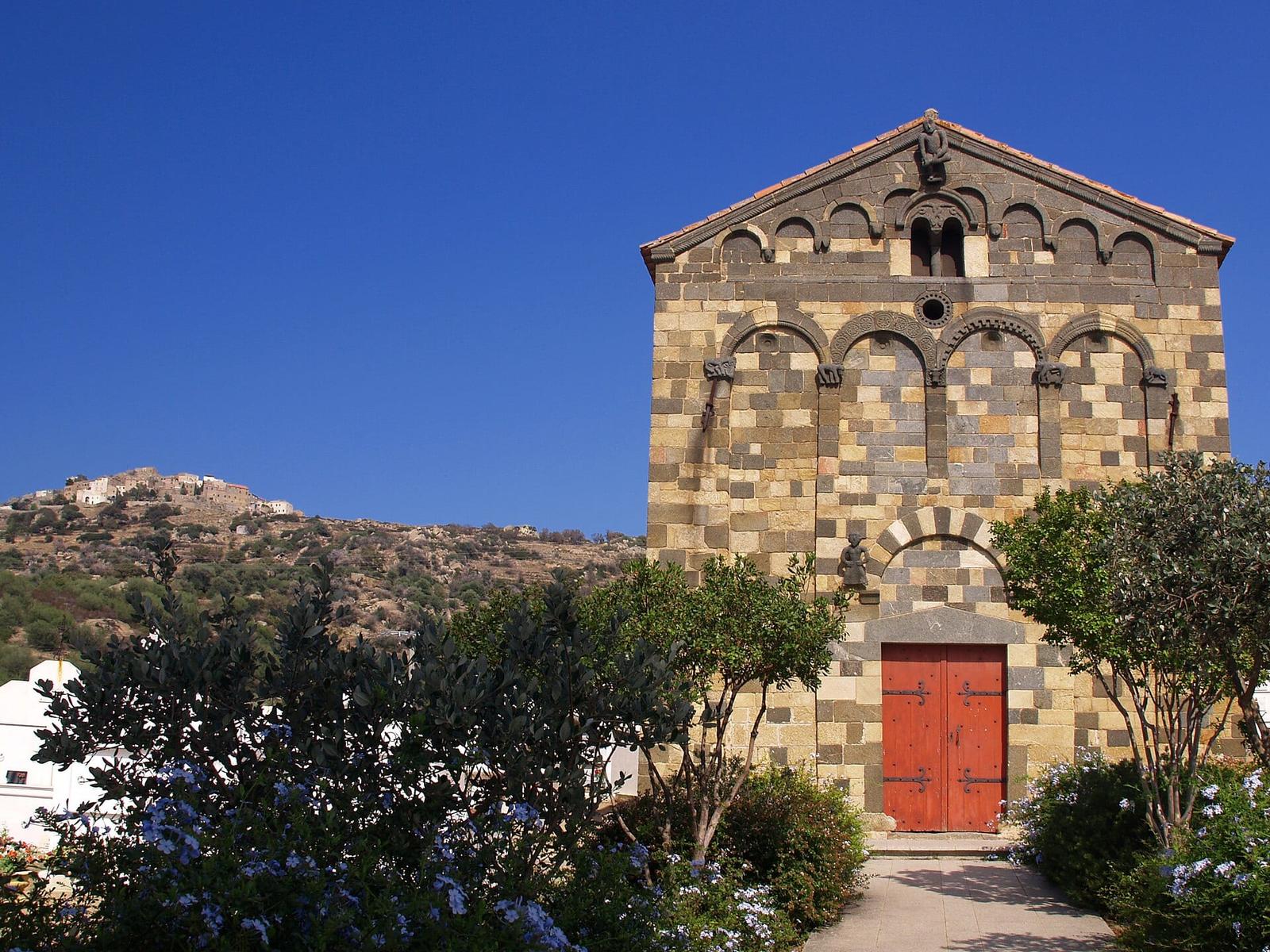

In the middle of Aregno cemetery, between Calvi and L'Île-Rousse, a small Romanesque church built of three colours of granite draws every lover of Pisan art in the Balagne. People come for its facade, its naive carvings and a curious figure pulling a thorn from his foot. Here is how to find it, what to know about opening, and what to look for.
The church at a glance
- Where: in the village cemetery of Aregno, in the Balagne (Haute-Corse), between Calvi and L'Île-Rousse.
- Date: late 11th or early 12th century, during Pisan rule.
- Price: the Corsican tourist board publishes no admission price.
- Opening: no opening hours are published. The exterior, which carries most of the decoration, can be seen from the cemetery.
- Time needed: allow 30 minutes.
- Best for: lovers of Romanesque art, photographers, and anyone driving the Balagne villages route.
- Good to know: to see the frescoes inside, check beforehand with the Calvi-Balagne tourist office or Aregno town hall.

Why the Church of the Trinity in Aregno is worth the detour
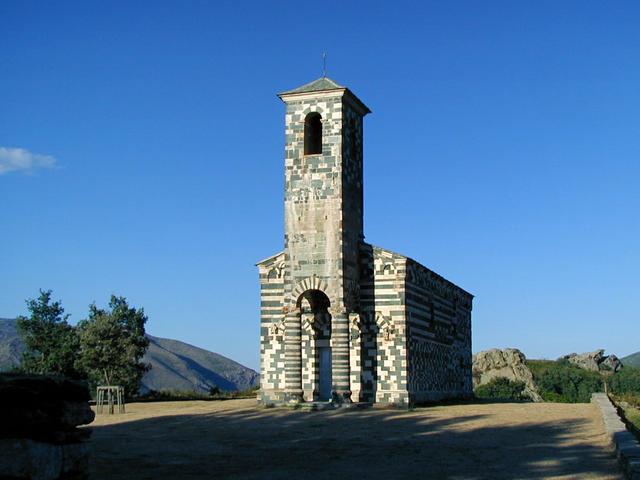
Corsica has kept dozens of Romanesque churches from the Pisan period, when the island was ruled by Pisa. In the north, two are famous for their coloured walls: San Michele de Murato, in the Nebbio, and the Trinity at Aregno, in the Balagne. If you liked one, go and see the other.

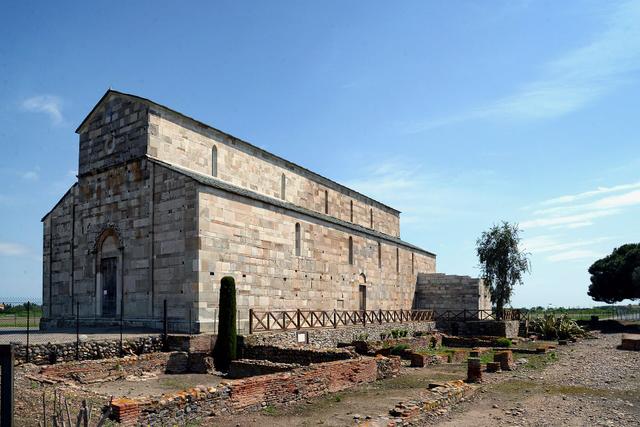
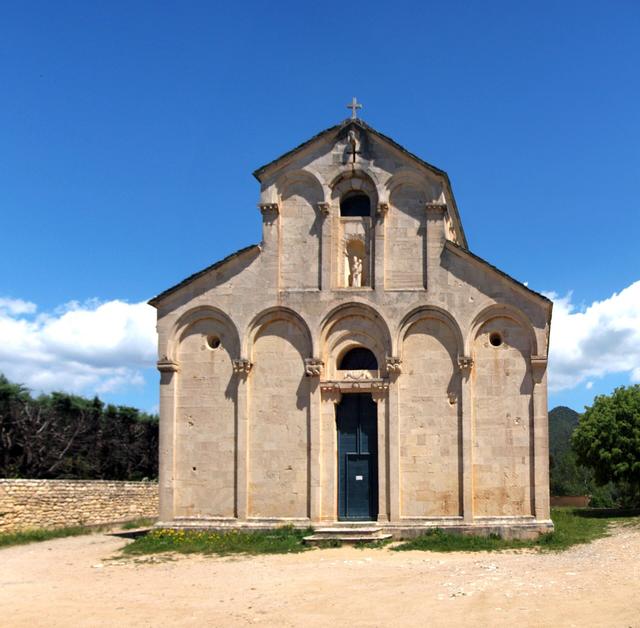
The Trinity is small: a single nave, a semicircular apse, a tiled roof. What stands out is the facade. The builders alternated blocks of granite in three colours. The Corsican tourist board reports a symbolic reading: beige for the Father, green for the Son, red for the Holy Spirit. The Trinity, to which the church is dedicated, is written in the stone.
The French Ministry of Culture dates it to the late 11th century, "during the Pisan occupation". Other descriptions place it around 1100 or in the first half of the 12th century. It has been listed as a historic monument since 11 August 1883. It belongs to the commune.
Its double name comes from its double dedication: to the Holy Trinity and to Saint John (San Giovanni).
A church that was also a court
The Calvi-Balagne tourist office points out that the Trinity was a pievan church, the main church of a pieve, the religious and administrative district of old Corsica. Its role was not only religious. Until the early 16th century, it also served as a court of first instance.
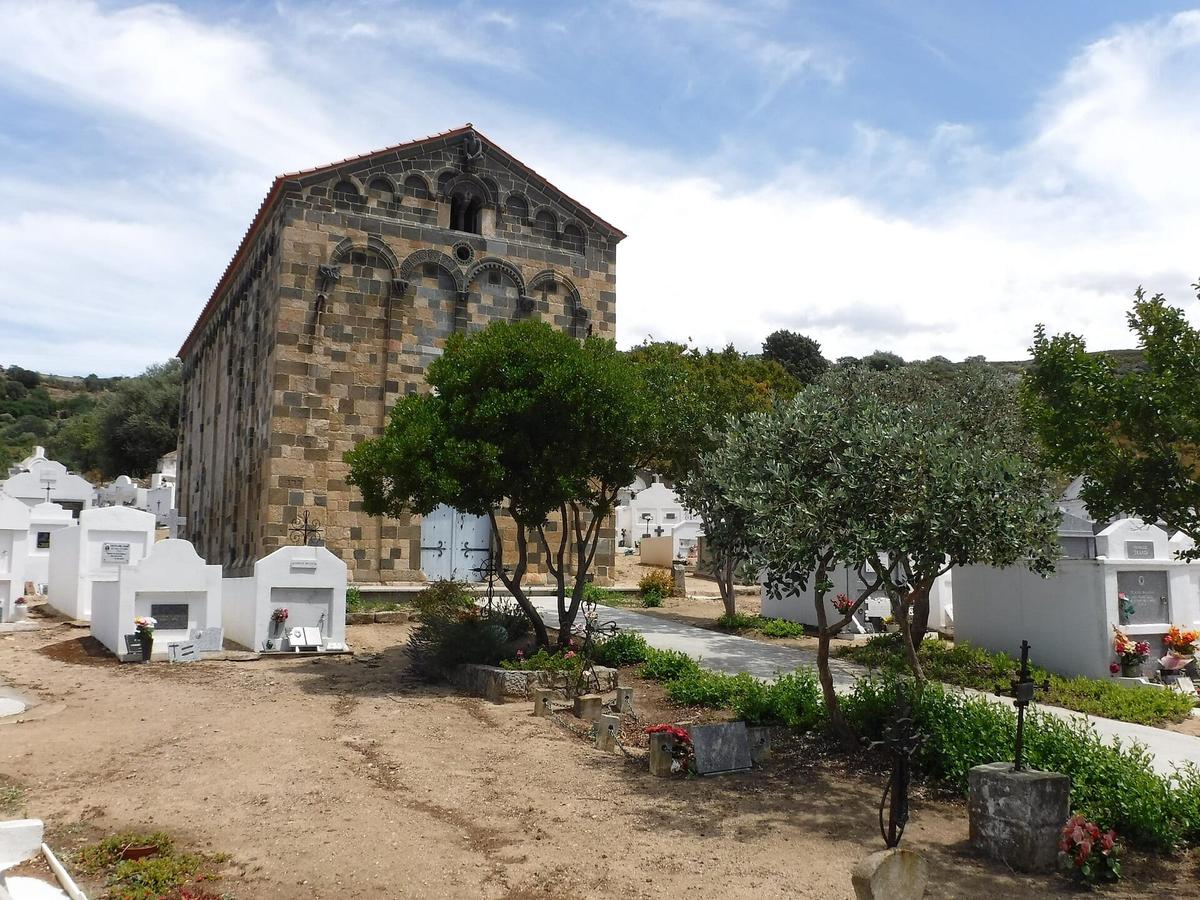

It was a burial place too. Until the early 19th century, the people of Aregno and Sant'Antonino were buried there in a common grave, the "arca". The cemetery that surrounds it today carries on that role. The name Aregno itself is said to come from "aringo", a word linked to assemblies.
In 2011, an archaeological assessment was carried out in the nave ahead of a restoration campaign.
Is there an entry fee?
The Corsican tourist board publishes no admission price for the church, and no ticket office is mentioned. Official sources do not announce any regular guided tours either. For a guided group visit, contact the Calvi-Balagne tourist office.
European Heritage Days, in mid-September, are often an occasion for openings and tours in the Balagne villages. The tourist office publishes the programme every year.
If you are looking for an organised activity in the area (a boat trip to Scandola, a walk around the citadel of Calvi), most leave from Calvi.
Partner links: if you book through these links, we earn a commission at no extra cost to you. Partner links · Learn more
When is the church open?
No opening hours are published for 2026, either by the Corsican tourist board or by the tourist office. The Guide du Routard also advises checking with the tourist office or Aregno town hall before you come.
In practice, keep this in mind:
- The exterior can always be seen. Facade, carvings, blind arcades and east end can be viewed from the cemetery. That is where most of the decoration is.
- The interior is not guaranteed. If you want to see the frescoes, call ahead. The tourist board gives two numbers: +33 4 95 65 16 67 and +33 4 95 61 70 34.
- Respect the place. The church stands in the middle of a working cemetery. Avoid coming during a funeral, keep your voice down and do not climb on graves for a photo.
The best time. The coloured granite looks its best in the late afternoon, when the sun is low. In high summer, midday is very hot and the light flattens the relief of the carvings.
How long does the visit take?
Allow 30 minutes to walk around the church and look at the carvings. Add half an hour if the interior is open, and another hour to go up to the village of Aregno and see its grand houses.
What to see at the Church of the Trinity

The three-coloured granite facade
Stand facing the entrance. The beige, green and red blocks are not placed at random: they form bands and patterns. The contrast is less striking than at Murato, where the stone is green and white, but the effect is warmer.
The door arch
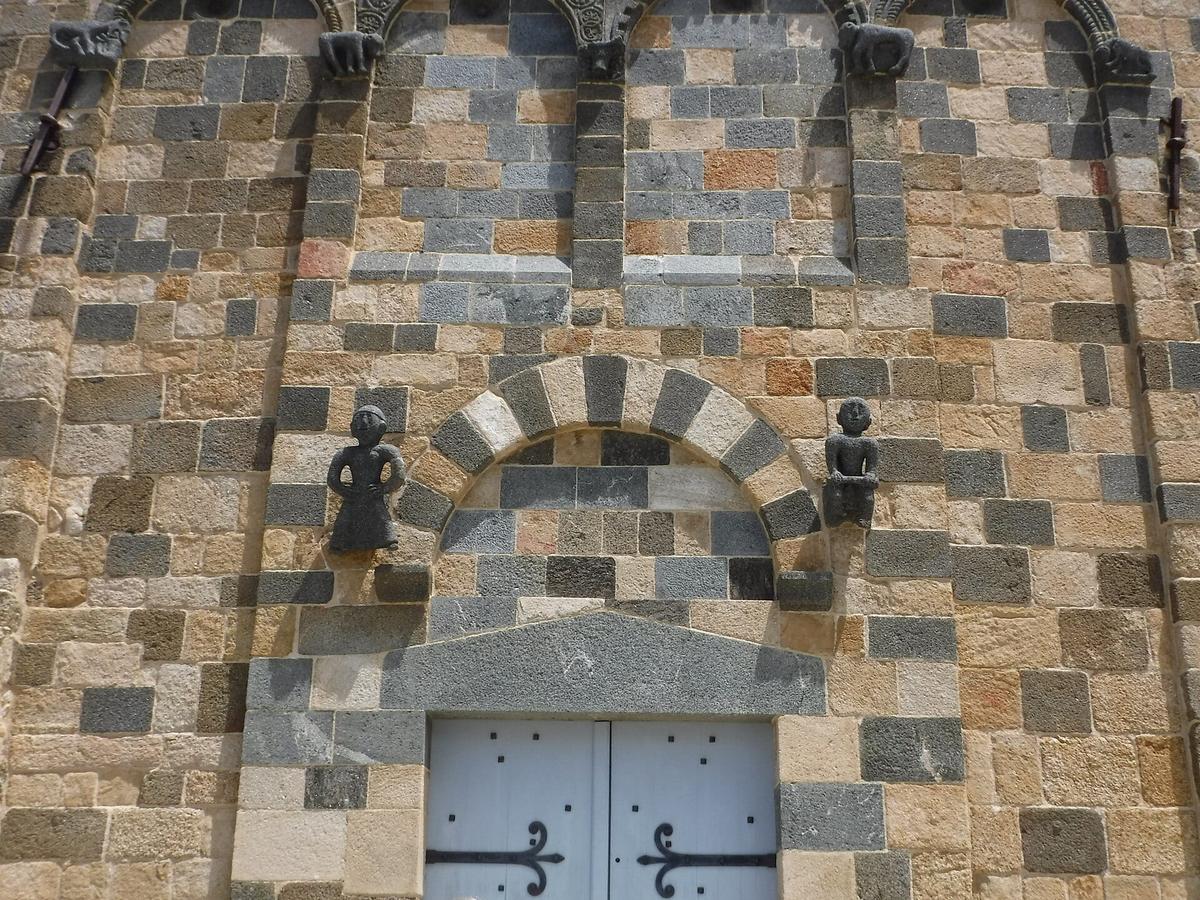
Above the door, count the voussoirs, the wedge-shaped stones that make up the arch. There are 7 dark ones and 8 light ones. According to the tourist office, this is no accident: seven is said to call the faithful to turn to God, and eight to symbolise the resurrection.
The thorn puller
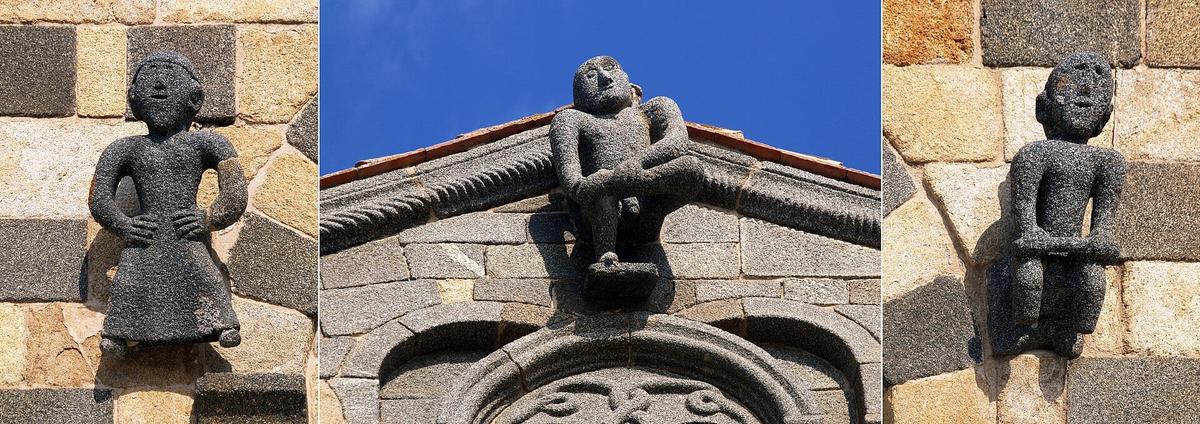
This is the church's best-known carving. On the gable of the facade, a seated figure pulls a thorn from his foot. The theme comes from antiquity and appears in other Romanesque churches. It is often read as an allegory of knowledge. Other figures carved in the round also decorate the facade.
The blind arcades and their corbels
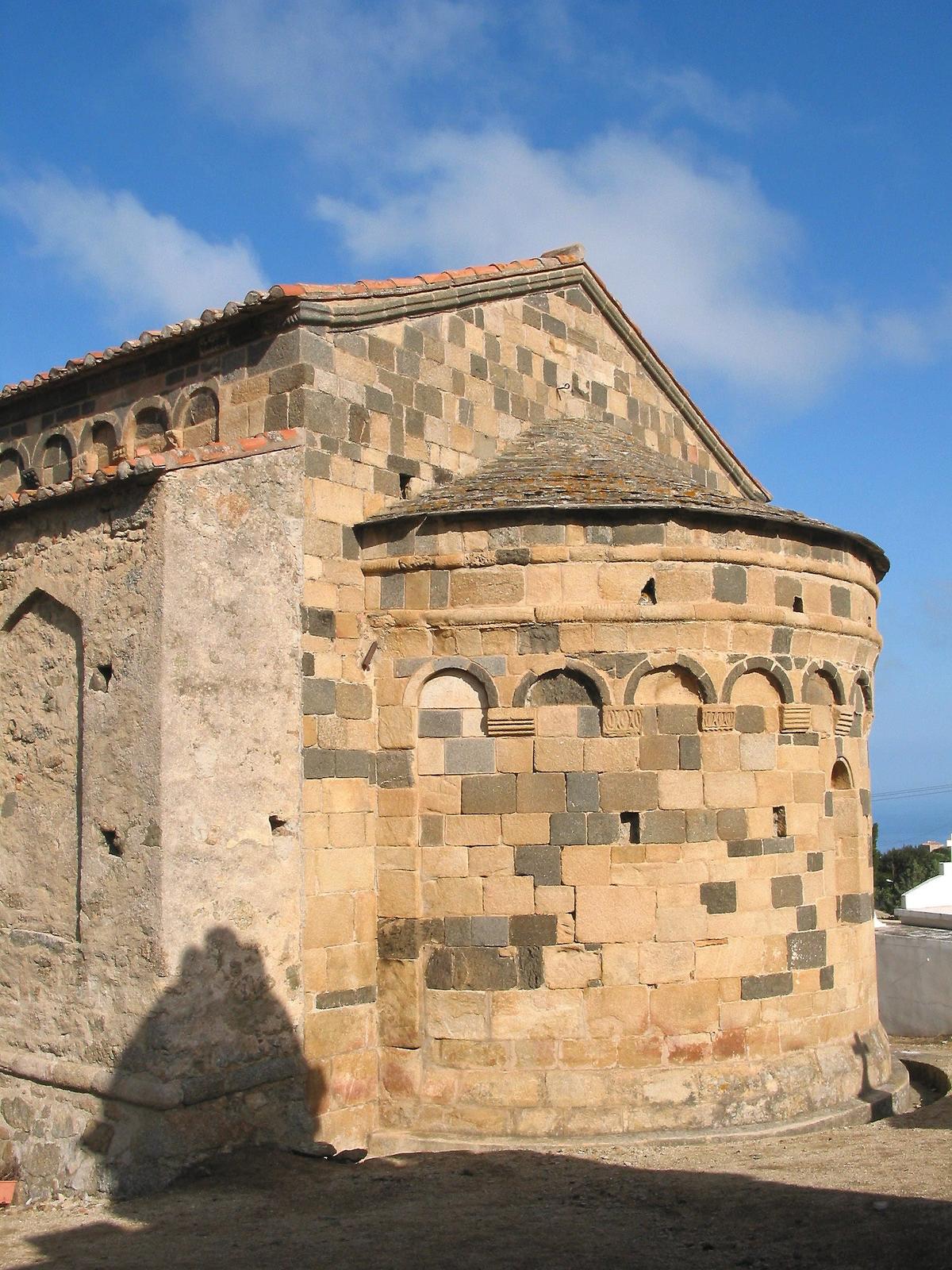
All around the church, round arches rest on small carved brackets, the corbels. They bear geometric patterns, foliage and animals; Wikipedia mentions bears, oxen and snakes. Walk all the way round, east end included: every corbel is different.
Our tip: bring binoculars or a telephoto lens. Several carvings are set high up and worn by time.
The 15th-century frescoes
The interior, under an open timber roof, keeps two 15th-century frescoes. One shows the four Doctors of the Church (Saint Augustine, Saint Gregory, Saint Jerome and Saint Ambrose), each holding a book. The other shows a saint slaying a dragon: depending on the description, Saint George, or the Archangel Michael weighing souls. The painted dates are read differently depending on the source, between about 1448 and 1458. Painted decoration on the apse arch has almost faded away.
The village of Aregno
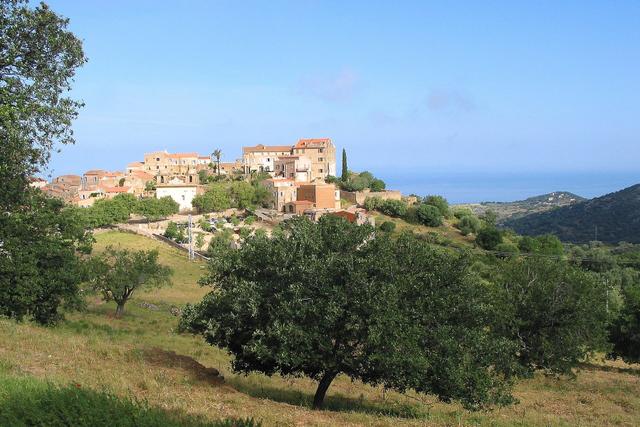
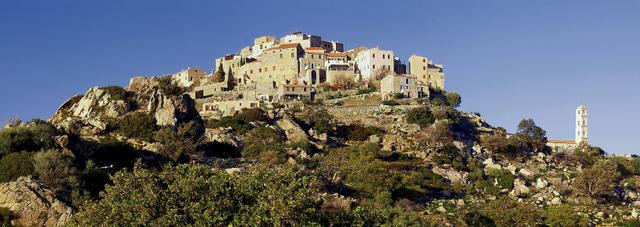
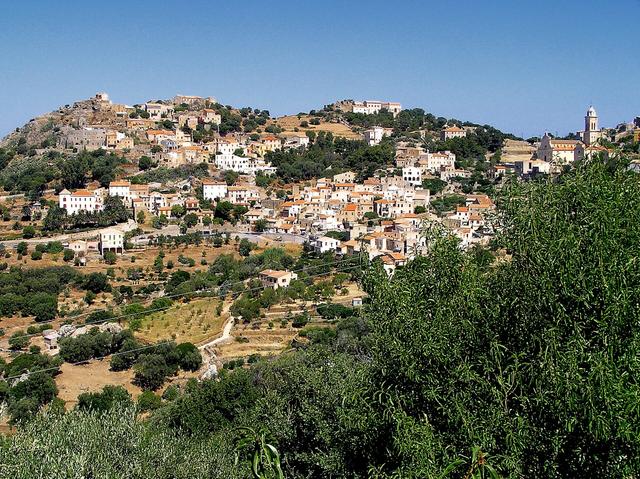
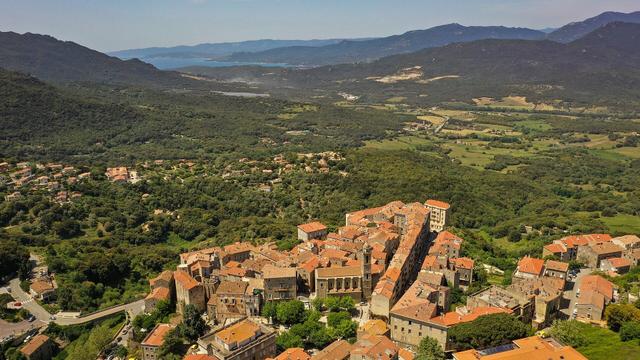
The church stands apart from the houses, in the cemetery. Afterwards, head into the village centre. Aregno, with its hamlets of Torre and Praoli, was a farming village at the heart of what was called the "garden of Corsica". The plain running down to the sea was covered in olive, almond, lemon and orange trees. Fires have destroyed much of these orchards.
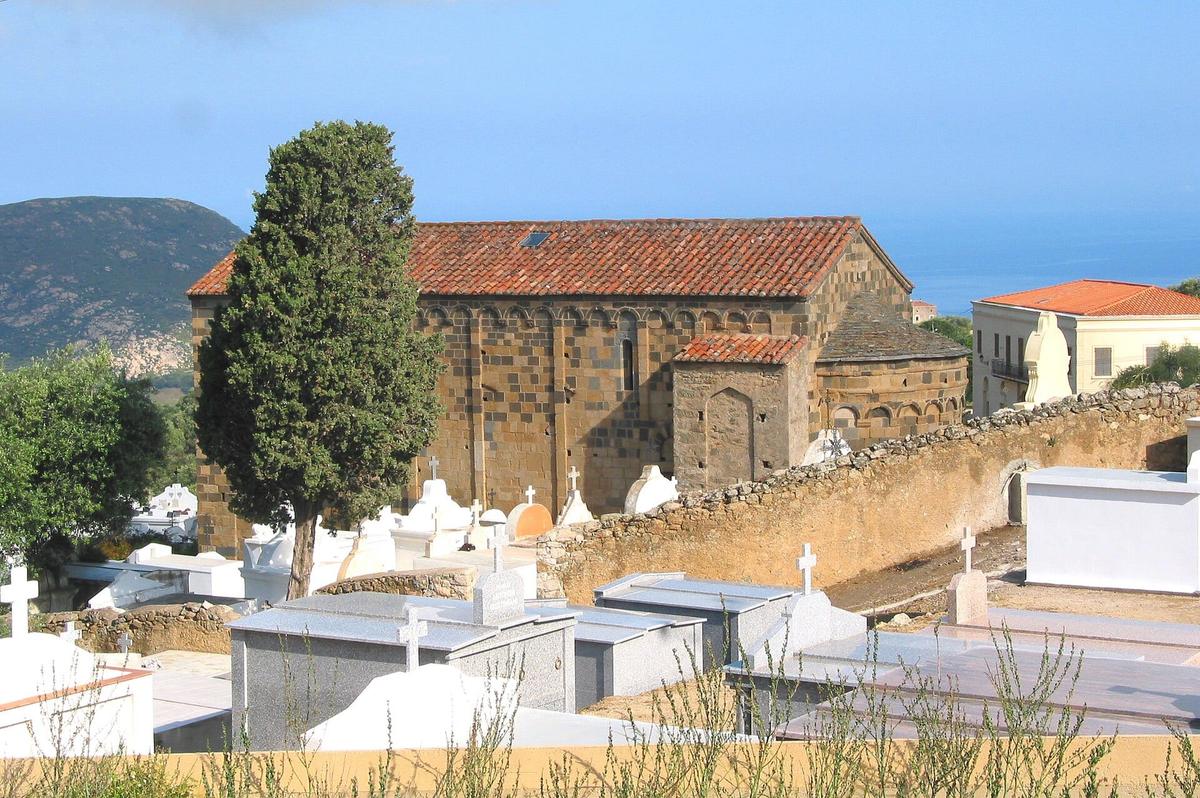

Traces remain in the grand houses, the palazzi, which show the past wealth of their owners.
Two dates to remember:
- In January, oranges are blessed during the procession of Saint Anthony the Abbot, patron of the parish church.
- In early August, the almond fair, A Fiera di l'Amandulu, brings together producers and craftspeople from the Balagne.
Visiting with children
The visit is short and outdoors. Turn it into a treasure hunt: find the thorn puller, count the voussoirs over the door, spot a bear or a snake among the corbels. Remind children that this is a cemetery: no running between the graves.
In summer, carry on to Aregno beach, by the sea, which according to the Routard is served in season by the little beach train.
Wheelchair access
No accessibility information is published. Access is through the cemetery, with paths that are sometimes sloping and uneven. If you use a wheelchair, check with the tourist office before you come.
How to get to the Church of the Trinity in Aregno
By car. This is the most practical option. Aregno is on the Balagne villages route, between Calvi and L'Île-Rousse, about twenty minutes from each. The church is not in the village centre: follow signs for the cemetery. Park without blocking access to the cemetery.
By train. In season, the Balagne train runs along the coast between Calvi and L'Île-Rousse and stops at Aregno beach. From there, walk up to the cemetery by road: bring water and good shoes.
Renting a car. Calvi (Sainte-Catherine airport) and Bastia are the most convenient arrival points for the Balagne.
What to see nearby on the same day
| Also worth seeing | Distance | Travel time |
|---|---|---|
| Calvi Citadel | 17 km | 25 min by car |
| Nebbio Cathedral (Santa Maria Assunta) | 55 km | 65 min by car |
| San Michele de Murato Church | 70 km | 85 min by car |
Approximate road distances and travel times.
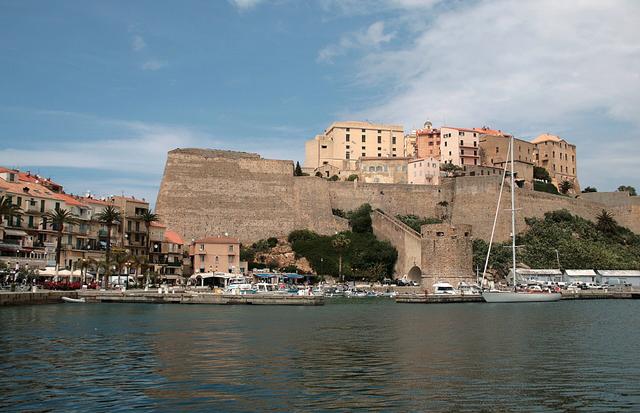
The citadel of Calvi, about twenty minutes away, is explored on foot, with its Genoese ramparts and views over the bay. See also: Calvi Citadel
For a day devoted to Pisan art, take the road to Saint-Florent. The Nebbio cathedral, on the edge of Saint-Florent, is another major Romanesque church from the Pisan period. See also: Nebbio Cathedral (Santa Maria Assunta) San Michele de Murato, in the hills south of Saint-Florent, completes the trio with its green and white walls. See also: San Michele de Murato Church
Boats to the Scandola nature reserve also leave from Calvi. See also: Scandola Nature Reserve Between L'Île-Rousse and Saint-Florent, the Désert des Agriates and its wild beaches, then the village of Nonza at the start of Cap Corse, extend the drive. See also: Agriates Desert, Nonza, Corsica
Where to eat and stay
For lunch, see what is open in the village depending on the season, or head down to the coast. Neighbouring villages on the Balagne route, such as Pigna, known for its craftspeople, instrument makers and its Festivoce festival in summer, also have places to eat.
To stay, L'Île-Rousse and Calvi are the most practical bases. L'Île-Rousse is a little closer to Aregno. Calvi is better placed for boat trips to Scandola.
Places to stay near L'Île-Rousse
FAQ
Is the Church of the Trinity in Aregno open?
No opening hours are published. The exterior, with its carvings, can be seen from the cemetery. For the interior, call the Calvi-Balagne tourist office or the town hall before you come.
Where is the church?
In the village cemetery of Aregno, away from the houses, in the Balagne, between Calvi and L'Île-Rousse.
How old is the Church of the Trinity?
It dates from the late 11th or early 12th century, the Pisan period. It has been a listed historic monument since 1883.
Why does the facade have three colours?
It alternates beige, green and red granite. Tradition sees in them the Father, the Son and the Holy Spirit.
What is the thorn puller?
A carving on the gable of the facade: a figure pulling a thorn from his foot, often read as an allegory of knowledge.
How long should I allow?
About 30 minutes, an hour with the village of Aregno.
Practical information
Address
Église de la Trinité, cimetière communal, 20220 Aregno, France
Directions · Phone+33 4 95 65 16 67
On site and nearby
- Nearest shops and pharmacy: Lumio, 5 km away Straight-line distance, based on OpenStreetMap.
- Emergencies: 112 (all emergencies, free from any phone), 15 (SAMU, medical emergency)
Around the site, on Google Maps
With children
Family days out nearby: Calvi Citadel (12 km), Agriates Desert (30 km), Scandola Nature Reserve (37 km)
Swimming pools and play areas nearby, on Google Maps
Facts checked on 11 November 2026. Sources: visit-corsica.com, pop.culture.gouv.fr, en.wikipedia.org, espacestrail.run, waymarking.com, en.balagne-corsica.com, routard.com
Map
In the same region
- Parc Galeafrom €10Free under 3