Oloron Cathedral (Sainte-Marie): planning your visit
Oloron Cathedral (Sainte-Marie) at a glance
- Opening hours 2026
- 9:00 – 19:00
- Admission
- Free
- Time needed
- about 30 min
- Where
- Oloron-Sainte-Marie
Facts checked on 11 November 2026. Full opening hours, reduced prices and access
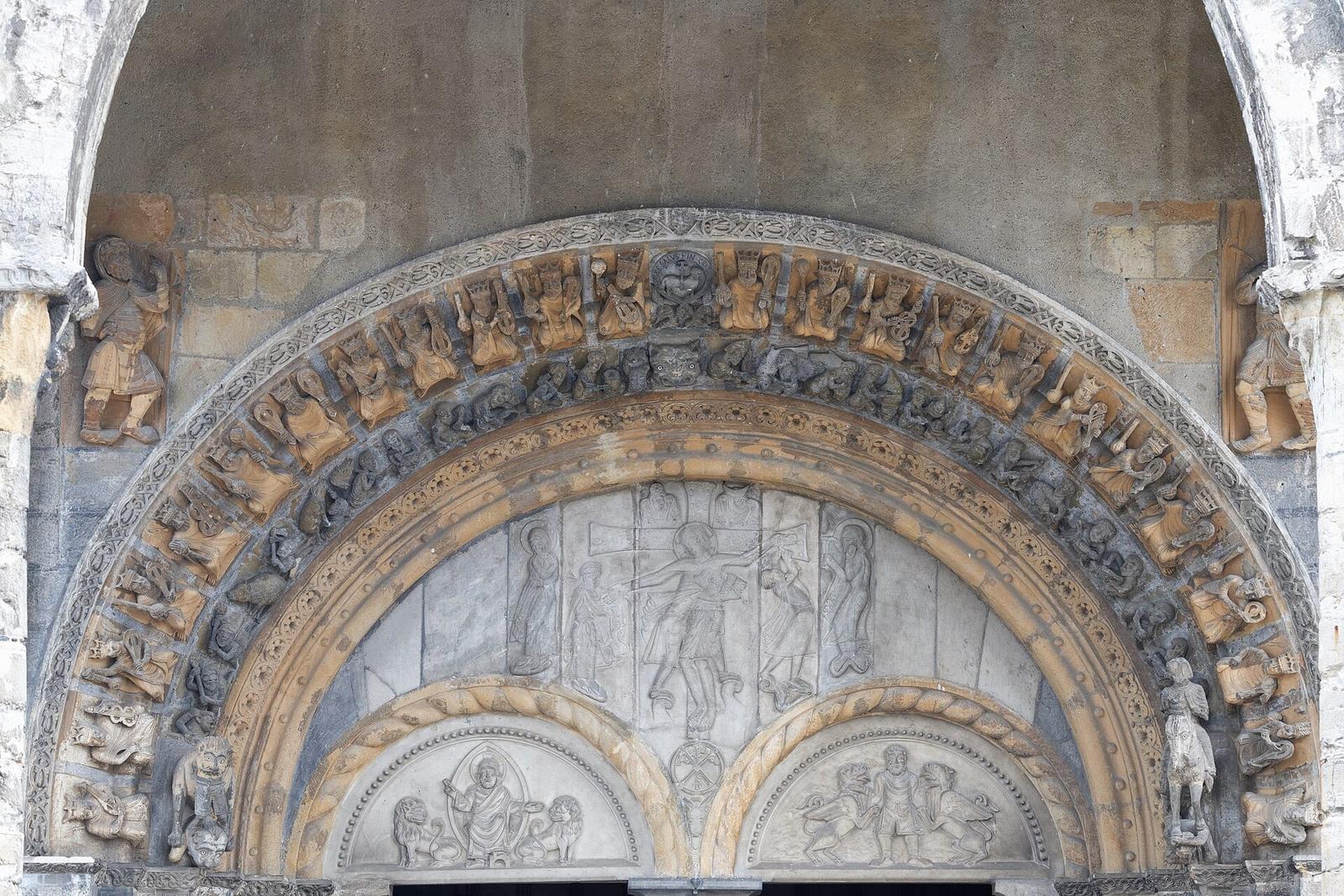

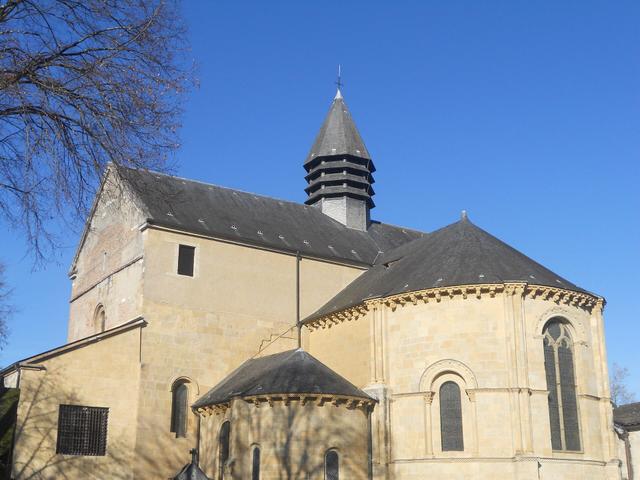
In the upper part of town, in the heart of the old bishops' quarter, the former cathedral of Sainte-Marie keeps one of the finest Romanesque portals in south-west France. It is a UNESCO World Heritage Site as part of the Routes of Santiago de Compostela. Entry is free every day: here are the opening hours, what to look for on the portal, the situation of the treasury and our tips.
Oloron Cathedral at a glance
- Where: in Oloron-Sainte-Marie, in the Béarn (Pyrénées-Atlantiques), Place de la Cathédrale, in the Sainte-Marie quarter, on the left bank of the Gave d'Aspe.
- Price: free entry, no booking.
- Open: every day of the year, 9:00 – 19:00.
- Time needed: allow 30 minutes for the portal and the interior, longer if you take time to read the carvings.
- Top priority: the 12th-century Romanesque portal, under the porch.
- Good to know: the treasury was burgled in November 2019. Check with the tourist office before counting on it.
Why visit Oloron Cathedral
Oloron was a bishopric for more than a thousand years. The first known bishop, Saint Grat, signed the acts of the Council of Agde in 506. The town therefore has two centres: Sainte-Croix, the quarter of the viscounts' castle, and Sainte-Marie, the bishops' quarter, across the river.

The present church was begun under Bishop Roger de Sentis, with the support of the Viscount of Béarn, Gaston IV, known as the Crusader. The date given by the town is 1102. According to the Pyrénées béarnaises tourist office brochure, the building work was partly funded by loot brought back from the First Crusade. Gaston IV had taken part in the capture of Jerusalem in 1099.
In 1302, a fire swept through the building. The nave was then given rib vaults and the east end was rebuilt in Gothic style, with an ambulatory and a ring of 5 radiating chapels. The side chapels were added in the 15th century. The portal survived: it is the great remnant of the Romanesque church.
The church remained a cathedral until the Revolution. The Concordat of 1801 abolished the diocese of Oloron, and Sainte-Marie became a parish church. People still call it "the cathedral".
In 1998, it was added to the UNESCO World Heritage List along with the other monuments of the Routes of Santiago de Compostela in France. Oloron is a stage on the Arles route (Via Tolosana), which continues through the Aspe valley and over the Somport pass into Spain.
Is Oloron Cathedral free to visit?
Yes. Entry is free, with no ticket or booking. It is a place of worship: during Masses and ceremonies, you cannot visit the interior. On Sunday mornings, come in the afternoon instead.
The portal is under the porch, so it is sheltered. You can look at it at any time, even when the church is closed.
Guided tours. The town's heritage department and the Haut-Béarn Pays d'art et d'histoire organise tours and events, mainly in summer and during European Heritage Days. The programme changes every year: ask the Oloron tourist office (+33 5 59 39 98 00) or the town hall heritage department (+33 5 59 39 99 99).
Groups. For groups, the Pyrénées béarnaises tourist office offers a guided tour of the cathedral in 2026 at a flat rate of €150, for 120 minutes, transport not included.
Opening hours 2026
The Béarn tourist board gives daily opening, from 1 January to 31 December 2026, 9:00 – 19:00.
The best time. The portal faces west. In the late afternoon, the light comes in under the porch and brings out the relief of the carvings. In the morning it is in shadow and the details of the arches are harder to make out.
On Sundays. A market is held in front of the church on Sunday mornings. It is lively, but it is also Mass time: come afterwards instead.
Is the treasury open?
The cathedral treasury was set up inside the church and opened in 2004. It displayed liturgical vestments from the 16th to the 19th century, gold and silverware and a nativity scene protected as a historic monument. In 2019, it had 3244 visitors.
On the night of 3 to 4 November 2019, thieves rammed a door of the church with a car, then looted the treasury display cases. Several pieces of gold and silverware were taken. The UNESCO site management plan, published by the town in 2022, states that the treasury has been closed since the theft.
We found no announcement of a reopening for 2026. Before making the trip for the treasury, call the tourist office. The church and the portal remain free to visit.
How long does the visit take?
Half an hour is enough to walk around the interior and look at the portal. If you love Romanesque sculpture, allow more: the arches hold dozens of small scenes, and it takes time to pick them out one by one. Add an hour if you then want to walk down to the Sainte-Croix quarter and its Romanesque church, across the river.
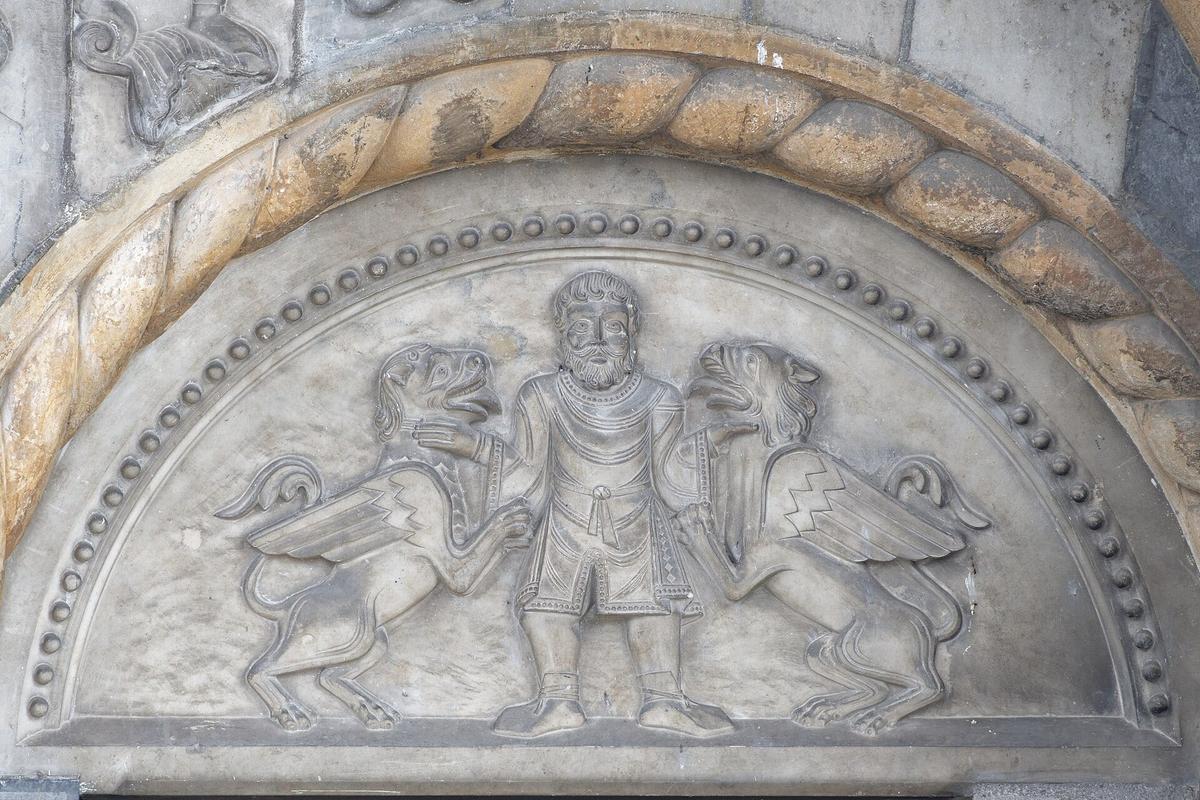

What to see on the Romanesque portal
This is the main reason for the visit. The tourist office puts it simply: the portal "alone makes its reputation". It was designed in the early 12th century and its arches were carved around the middle of the same century. The tourist office brochure attributes it to two sculptors.
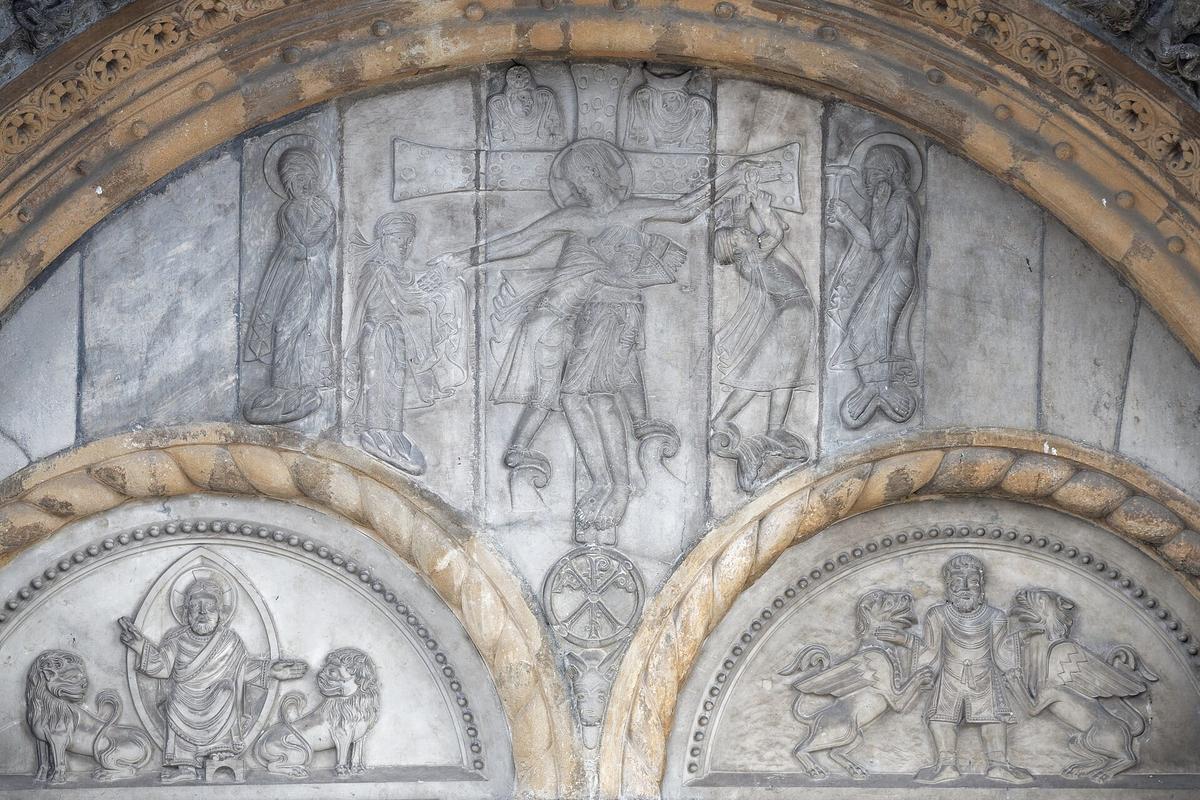

The tympanum. It is made of marble slabs and shows the Descent from the Cross. The town points out that this scene, inspired by Byzantine models, is unique in the region. The tympanum rests on two round arches carried by a central column.
A reused slab. One of the marble slabs of the tympanum is reused from antiquity: it bears a figure of the god Mars. The 12th-century sculptors took a Roman stone and worked it into a Christian scene.
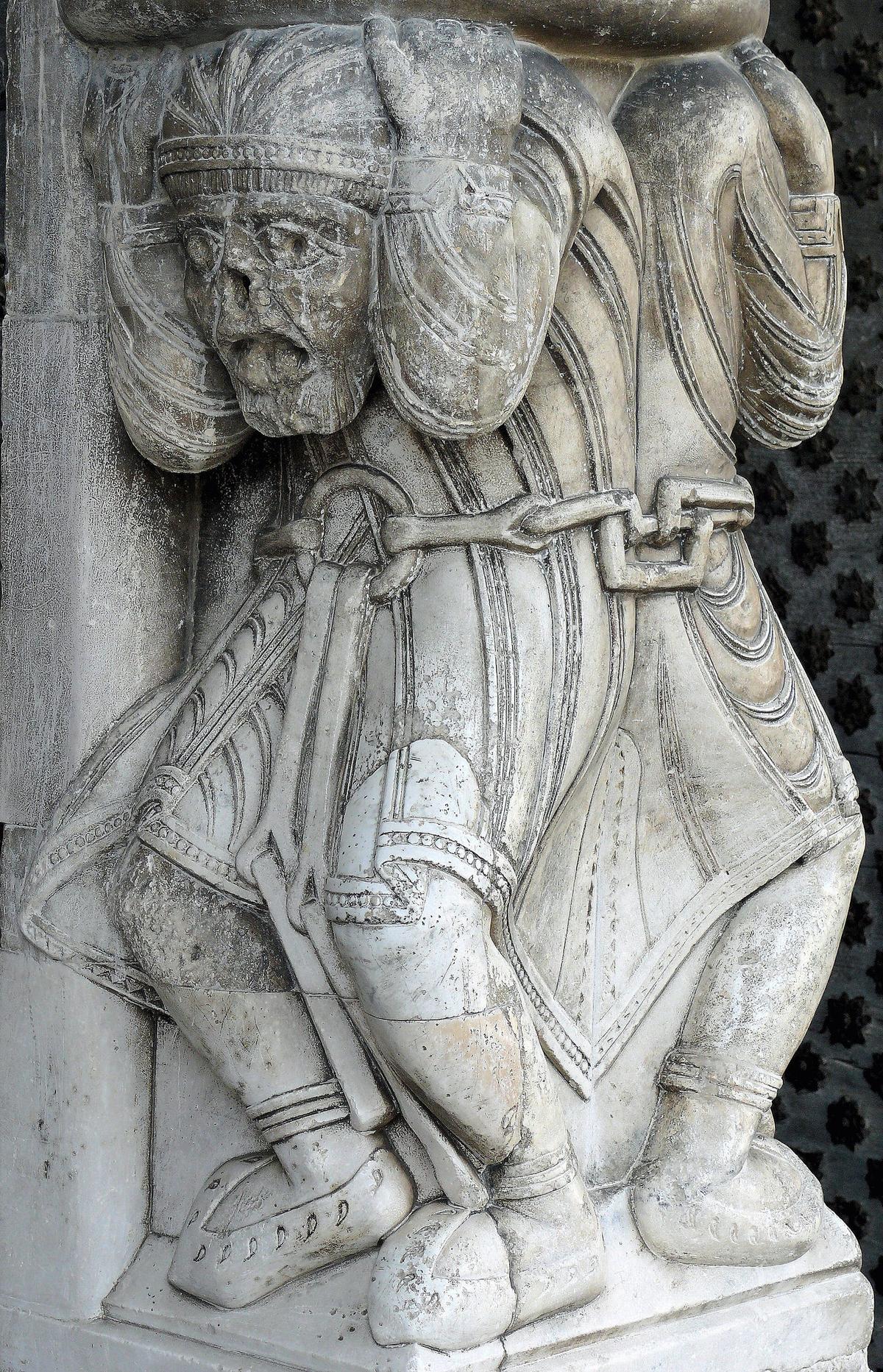
The two chained prisoners. At the foot of the trumeau, two chained men hold up the central column. The historic monuments record describes them as prisoners serving as caryatids. They are often seen as defeated Saracens, echoing Gaston IV's crusade, but that is an interpretation.
The 24 Elders of the Apocalypse. The main arch lines up the 24 Elders who surround Christ in the Book of Revelation.
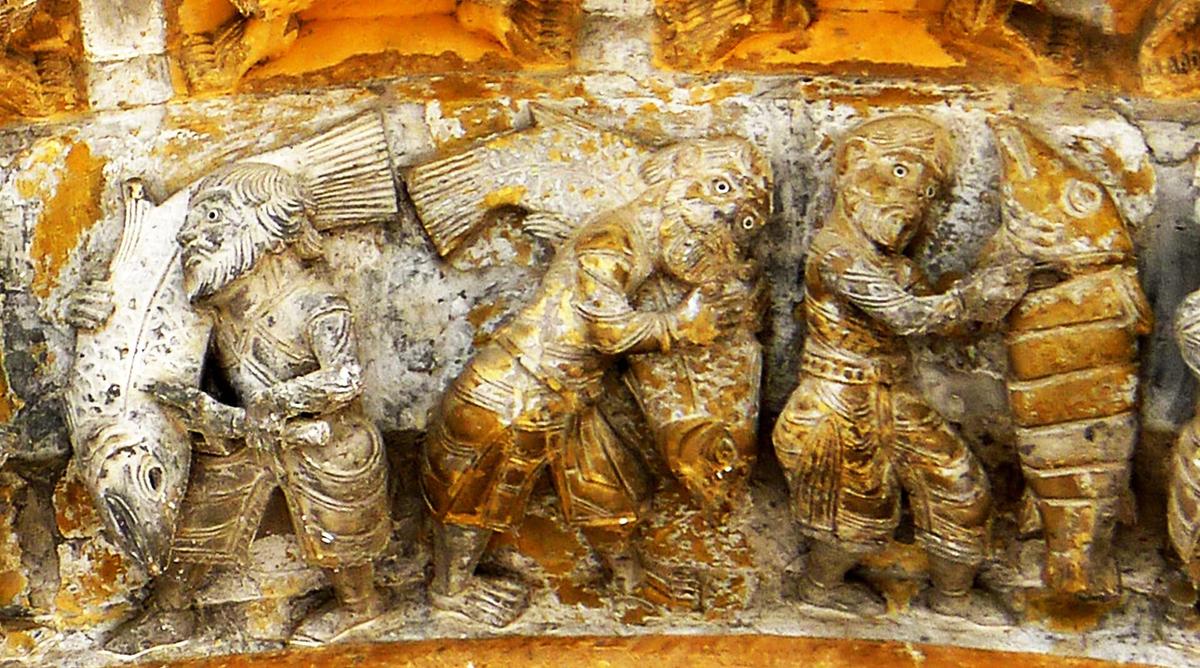
Everyday life. Another arch shows scenes of daily life, including a banquet and the grape harvest. It is the liveliest part of the portal. Take time to follow the arch from left to right.
The horseman. At the foot of the arch, a horseman whose horse tramples a man. Some see Emperor Constantine, others Gaston IV himself. The town remains cautious: the identification is a hypothesis.
A tip. Bring binoculars or use your phone's zoom. The scenes at the top of the arch are small and hard to make out with the naked eye.
What to see inside
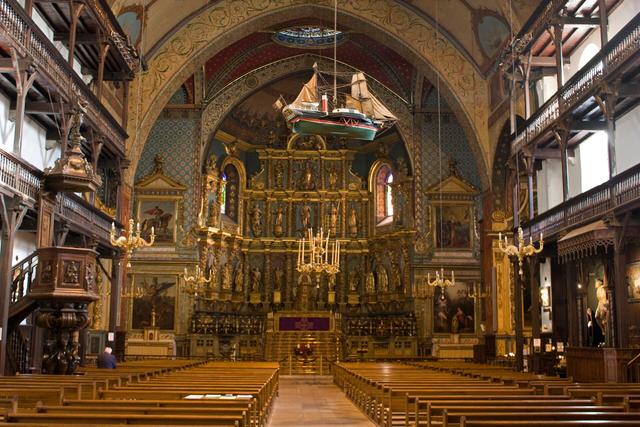
The Gothic nave and choir. The nave is 14.5 metres high. The choir, taller, rises to 18.5 metres. The church is 57 metres long overall, including 11 metres for the porch, and 33 metres wide.
The organ. In 1650, Bishop Pierre de Gassion gave the cathedral an organ and a gallery. During the Revolution, the instrument was dismantled to recover 14.5 quintals of metal. The present organ was built in 1870 by Aristide Cavaillé-Coll, in the old case. The Oloron.Orgues association gives concerts several times a year and presents the instrument during Heritage Days.
An eventful history of protection. The cathedral was first listed as a historic monument in 1841. It was delisted in 1886, after unauthorised building work, then listed again in 1939.
Saint Grat. The feast of Saint Grat, the first bishop of Oloron, is held every year around 19 October.
Visiting with children
A cathedral is not always an easy outing with children. The Oloron portal is an exception: its small scenes read like a comic strip. Ask them to find the banquet, the grape harvest, the horseman or the two chained prisoners. The tourist office also mentions a children's workshop on site; ask at the front desk for dates.

During European Heritage Days, the town holds family workshops, readings and a "Romanesque versus Gothic" quiz in front of the church. It is a good time to come with children.
The Sainte-Marie quarter
Do not leave without a short walk around the church. The Sainte-Marie quarter is the old bishops' town: cobbled streets, old houses, small shops and workshops. Across the river, the Sainte-Croix quarter, perched on its hill, keeps the Romanesque church of Sainte-Croix and the memory of the castle of the viscounts of Béarn.

How to get there
By train. Oloron-Sainte-Marie station, on the Pau to Canfranc line, is about 1 km from the cathedral. Allow a quarter of an hour on foot, uphill at the end.
By car. Oloron is about 35 km south-west of Pau, or 40 minutes. The tourist office advises parking at the Daguzan car park, then walking to the cathedral. Coaches can park nearby.
From the town centre. The tourist office is on Allées du Comte-de-Tréville. From there, you can walk to the cathedral, crossing the river.
Renting a car. To combine Oloron, the Soule, the Aspe valley and Pau, a car is the simplest option. Pau, with its station and airport, is the best starting point.
Partner links: if you book through these links, we earn a commission at no extra cost to you. Partner links · Learn more
What to see nearby on the same day
| Also worth seeing | Distance | Travel time |
|---|---|---|
| Château d'Andurain de Maytie | 32 km | 40 min by car |
| Château de Pau | 35 km | 40 min by car |
| Bétharram Caves | 45 km | 55 min by car |
Approximate road distances and travel times.
About forty minutes to the west, in the Soule, the Château d'Andurain de Maytie in Mauléon is a Renaissance mansion that is still lived in. See also: Château d'Andurain de Maytie To the east, the Château de Pau, birthplace of Henri IV, is easy to fit into the same day. See also: Château de Pau Further on, on the road to Lourdes, the Bétharram caves are explored partly by boat and by little train. See also: Bétharram Caves
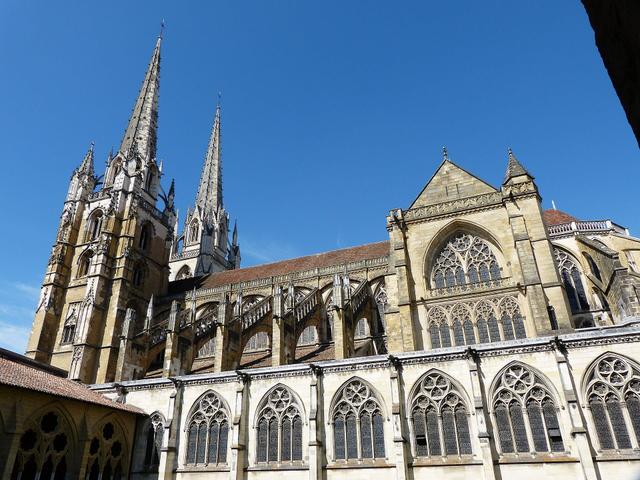
If you are following the Way of St James, two other UNESCO-listed stages are in the region: Bayonne cathedral, on the coast See also: Bayonne Cathedral (Cathédrale Sainte-Marie), and Saint-Bertrand-de-Comminges, at the foot of the central Pyrenees. See also: Saint-Bertrand-de-Comminges Cathedral Saint-Jean-Pied-de-Port, where the crossing of the Pyrenees begins, is about 1 hour 15 minutes by road. See also: Saint-Jean-Pied-de-Port For a prehistory outing, the decorated cave of Gargas is further east, in the Hautes-Pyrénées. See also: Gargas Cave, Basque Country and Pyrenees
Where to eat and stay
The Sainte-Marie quarter has cafés and restaurants around the cathedral. The town centre, across the river, has more choice. Try garbure, the Béarn cabbage and vegetable soup, and the sheep's cheese from the Aspe and Ossau valleys.
Oloron is a good base for exploring the Aspe and Barétous valleys. Pau has more hotels if you want to combine your visit with the château and the Boulevard des Pyrénées.
Places to stay near Oloron-Sainte-Marie
FAQ
Is there an entry fee for Oloron Cathedral?
No, entry is free every day. Only guided group tours are charged.
What are the opening hours of Sainte-Marie Cathedral?
It is open every day of the year, 9:00 – 19:00, according to the tourist board. Avoid Mass times for your visit.
Why is the cathedral on the UNESCO list?
Since 1998, it has been part of the "Routes of Santiago de Compostela in France" World Heritage Site. Oloron is a stage on the Arles route towards the Somport pass.
Can I visit the treasury?
The treasury was looted in a burglary in November 2019 and has been closed since. No reopening had been announced when we checked: call the tourist office before you come.
What does the portal show?
The Descent from the Cross on the tympanum, the 24 Elders of the Apocalypse and scenes of daily life on the arches, and two chained prisoners at the foot of the trumeau.
How long should I allow?
About 30 minutes for the church and the portal, an hour or more if you add the Sainte-Croix quarter.
Practical information
Opening hours 2026
| 1 January 2026 to 31 December 2026 | 9:00 – 19:00 |
|---|
Official ticket-office prices 2026
Free admission
Address
Église Sainte-Marie, place de la Cathédrale, 64400 Oloron-Sainte-Marie, France
Directions · Phone+33 5 59 39 98 00
On site and nearby
- Nearest shops and pharmacy: Oloron-Sainte-Marie, less than 1 km away Straight-line distance, based on OpenStreetMap.
- Emergencies: 112 (all emergencies, free from any phone), 15 (SAMU, medical emergency)
Around the site, on Google Maps
With children
Family days out nearby: Château de Laàs (28 km), Château de Morlanne (36 km), Bétharram Caves (36 km)
Swimming pools and play areas nearby, on Google Maps
Swimming poolsPlaygroundsLeisure parks
Family activities around Oloron-Sainte-Marie on GetYourGuide
Facts checked on 11 November 2026. Sources: tourisme64.com, pyrenees-bearnaises.com, oloron-ste-marie.fr, pop.culture.gouv.fr, en.wikipedia.org
Map
In the same region
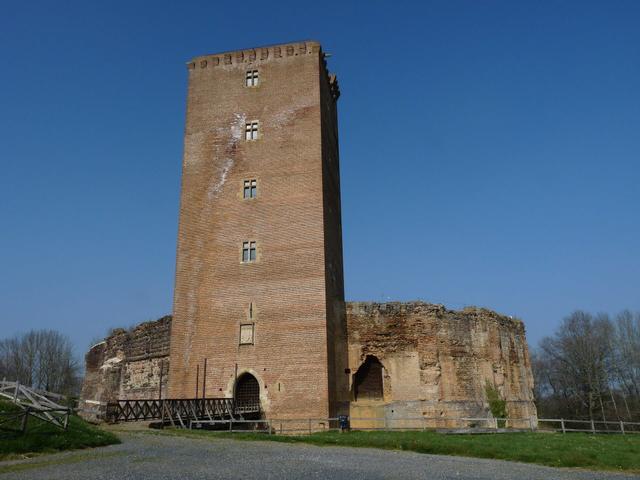
- Château de Morlannefrom €7Free under 7
- Gouffre d'Esparrosfrom €12.50Free under 4