Murbach Abbey: visiting the Romanesque church of the Florival
Murbach Abbey at a glance
- Admission
- Free
- Where
- Murbach
Facts checked on 12 November 2026. Full opening hours, reduced prices and access
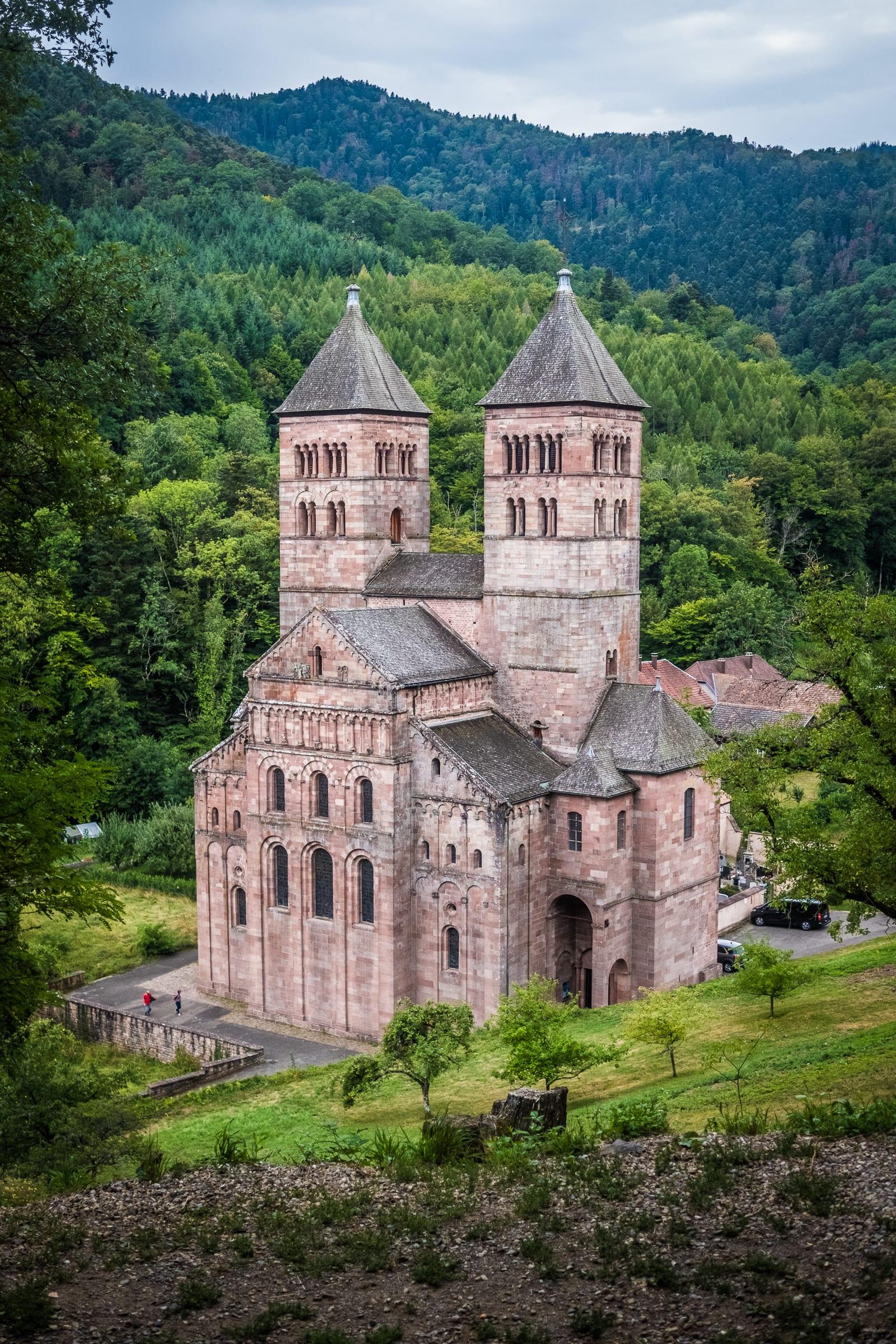

At the end of a wooded side valley a few kilometres from Guebwiller, two red sandstone towers rise above a village of a handful of houses. Together with the choir and transept, they are all that is left of Murbach Abbey, once one of the most powerful in the Holy Roman Empire. Entry is free. Here are the opening hours, what to look out for, the short walk up to the Loreto chapel and how to plan your visit.
Murbach Abbey at a glance
- Where: in Murbach, Haut-Rhin, in a side valley of the Florival (the Guebwiller valley), at the foot of the Grand Ballon in southern Alsace.
- Price: free entry. The mystery game sold by the tourist office costs €19.
- Open: every day, 9:00 – 18:00, according to the tourist offices.
- Time needed: 30 minutes for the church, an hour and a half with the climb to the Loreto chapel.
- Best for: lovers of Romanesque architecture, walkers, families with the mystery game.
- Good to know: this is the village parish church. Avoid Mass times and be discreet during funerals: the cemetery covers the site of the former nave.

Why visit Murbach Abbey
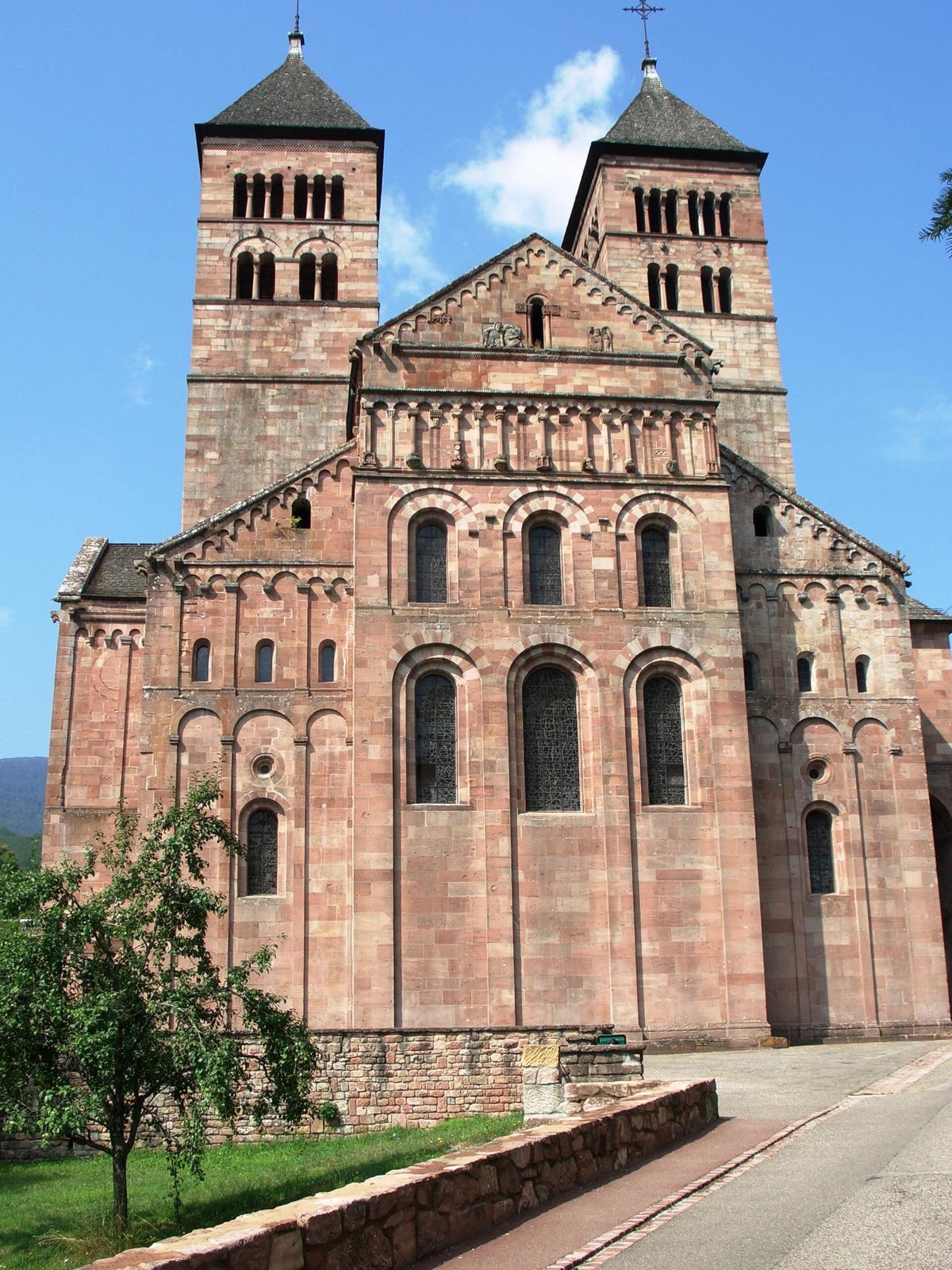
Because it is one of the most striking sights of Romanesque art in Alsace. Arriving along the narrow valley road, you first see a flat east end in red sandstone, framed by two tall square towers. The whole thing looks huge for a village of 165 inhabitants (2022). And it is: what survives is only part of the original church.
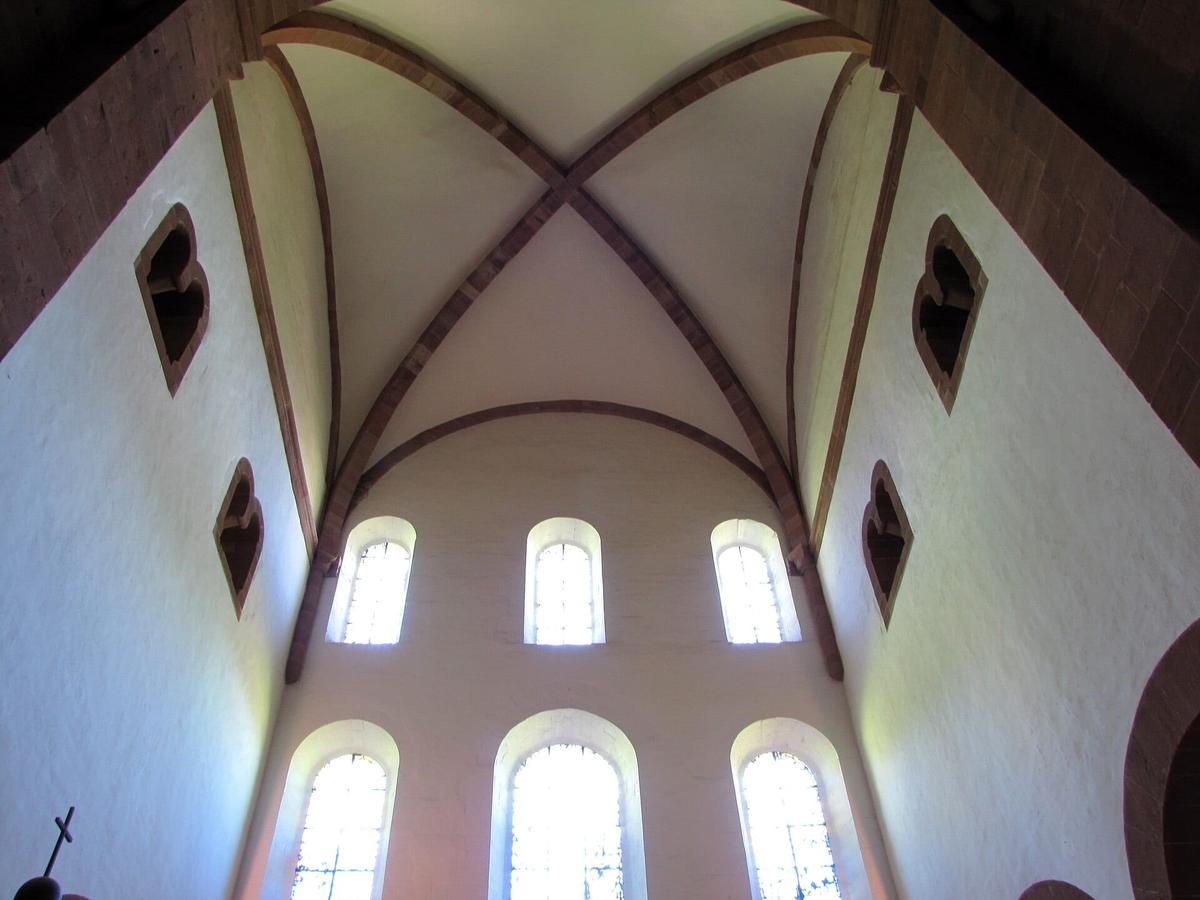

The abbey church of Saint-Léger lost its nave in the 18th century. Only the choir, the transept and the two towers are still standing. The site of the nave became the village cemetery. That missing piece gives the place its odd look: a front that is not really a front, standing behind the graves, with the forest right behind it.
The Guebwiller tourist office points out that in the 11th and 12th centuries Murbach was among the most powerful monasteries in the Holy Roman Empire. The church has been a listed historic monument since 1841, one of the very first in France.
History of Murbach Abbey
Founded in 727. Count Eberhard, of the Etichonid family (that of Saint Odile, whose nephew he was), founded the abbey in 727 and called on Saint Pirmin, a monk known for founding monasteries. The chosen spot was an isolated valley beside a stream, 420 metres above sea level.

A famous library. In the 9th century the Murbach library held about 340 books, a considerable number for the time. Two classical texts may owe their survival to it. In 1417, the Italian humanist Poggio Bracciolini is said to have found a manuscript of Lucretius' poem On the Nature of Things here, although some historians place the discovery at Fulda. In 1515, the Alsatian humanist Beatus Rhenanus found the only known manuscript of the Roman History of Velleius Paterculus here.
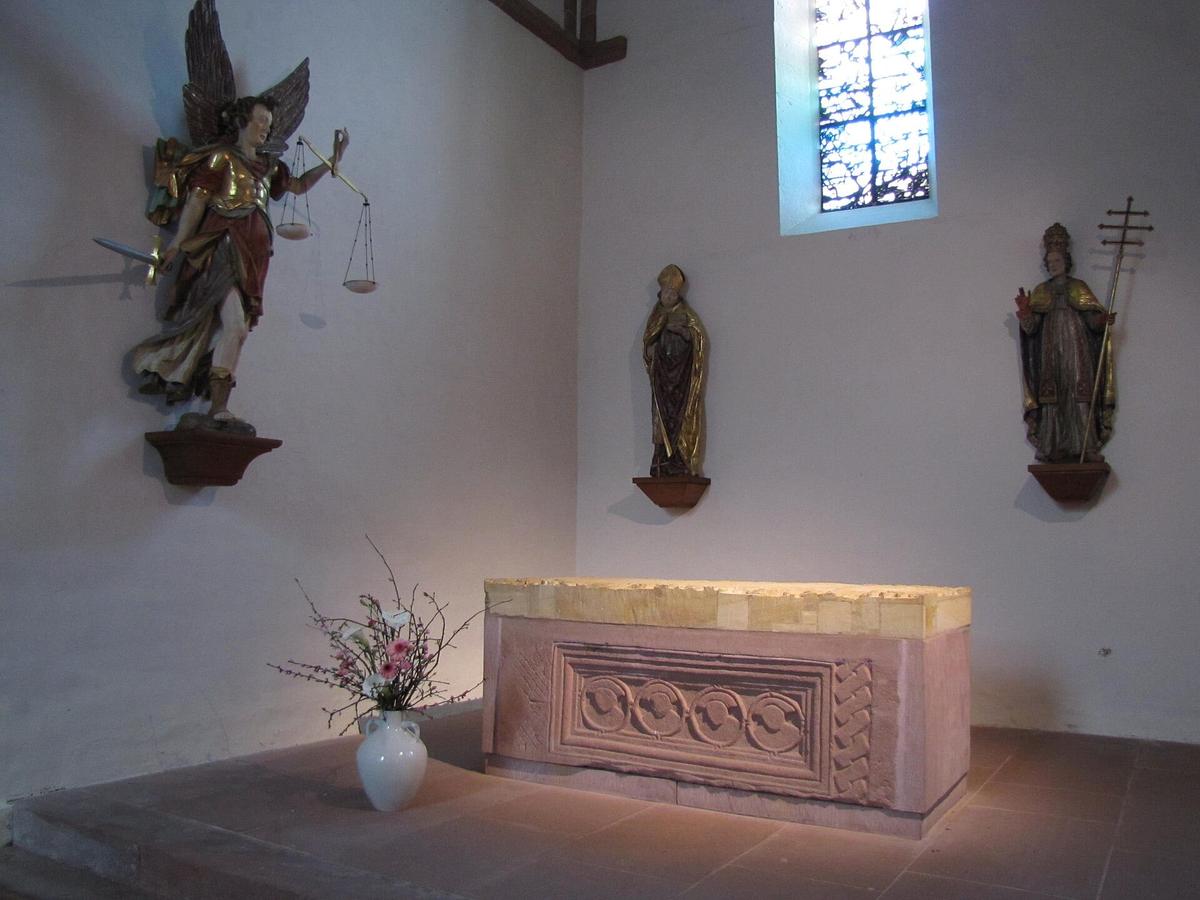
The seven martyred monks. In the 10th century, Hungarian horsemen raided the region. According to tradition, seven monks were killed and later venerated as martyrs. Historians doubt the legend, but the sarcophagus attributed to them is still in the church.
Abbots who were princes of the Empire. In 1228, Emperor Frederick II gave Abbot Hugo of Rothenburg the title of Prince of the Holy Roman Empire. His successors kept it until the French Revolution. To join this abbey, you had to prove 16 quarters of nobility: it was a monastery for the sons of great families.
A Swiss connection. The Swiss city of Lucerne grew out of a Murbach possession, first mentioned in 1178. In 1291, the abbey sold its rights over Lucerne to Rudolf of Habsburg. The sale played a part in the early days of the Swiss Confederation.
The Romanesque church. The exact date of construction is unknown. Specialists place it in the 12th century. It was consecrated in 1216 to the Holy Trinity, the Holy Cross, the Virgin Mary and Saint Leodegar (Saint Léger).
The demolished nave. In the 18th century, the monks wanted a Baroque church. In 1738, they had the three Romanesque aisles pulled down. The new building was never built. In 1759, the Pope allowed the monks to move to the more comfortable town of Guebwiller, where they started building the church of Notre-Dame. The abbey was secularised in 1764, and what remained of the abbey church became Murbach's parish church in 1765. The Revolution put an end to the chapter.
How much does it cost to visit Murbach Abbey?
Nothing. The Guebwiller tourist office lists it as a free, self-guided visit. Parking for cars and campervans is free too.
The only possible costs are:
- The mystery game "Le secret volé de l'abbaye de Murbach" (The stolen secret of Murbach Abbey): €19 for the game bag, for a team of 1 to 4 players (see the section on children).
- Guided tours for groups: booked through the tourist office, price on request.
Do you need to book?
Not for a self-guided visit. The church is open and there is no ticket.
In summer, the Guebwiller tourist office runs free guided tours of the abbey in German at 14:00 and in English at 15:15. The meeting point is in front of the church entrance. Booking with the tourist office is recommended. The exact dates of the season are not published on the page, so ask before you come.
Partner links: if you book through these links, we earn a commission at no extra cost to you. Partner links · Learn more
Murbach Abbey opening hours
Tourist listings give opening hours of every day, 9:00 – 18:00. No seasonal closure is mentioned.
Two things to bear in mind:
- Services. The abbey church is still a parish church. You cannot visit during Mass or a ceremony.
- Winter. Murbach lies at the bottom of a valley at 420 metres. The narrow access road can be slippery in snow or ice, so bring a warm jacket.
Our tip: come in the late afternoon on a fine day. The sun lights up the red sandstone of the towers, and the climb to the Loreto chapel is in the shade of the trees. On weekdays outside summer, you have a good chance of having the place almost to yourself.
How long does it take to visit Murbach?
The church itself takes 20 to 30 minutes: inside it is small, about 20 metres long and 10 wide according to the Structurae database. Add a walk around the outside to see the east end, the south doorway and the cemetery.
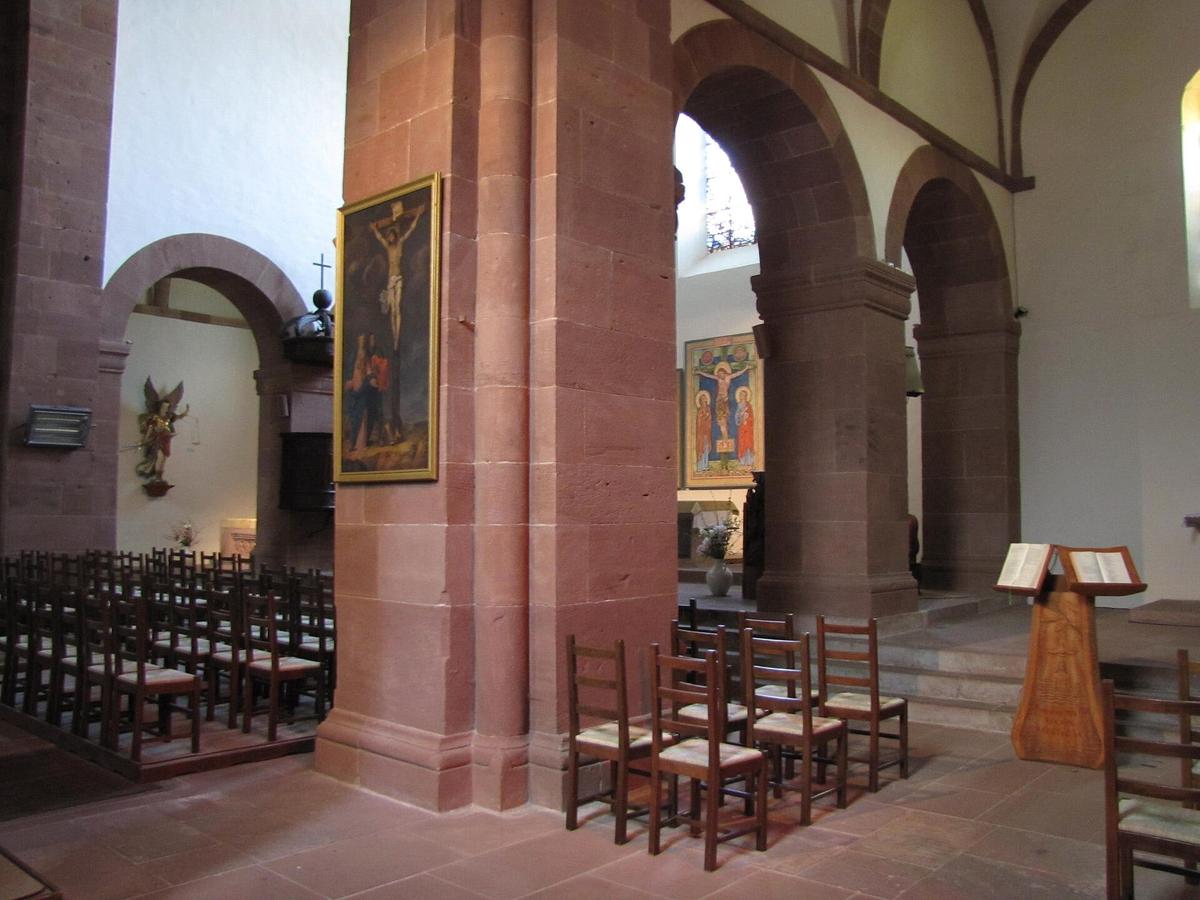

With the climb to the Loreto chapel along the Stations of the Cross and back, allow an hour and a half in total. With the mystery game, allow about 2 hours.
What to see at Murbach Abbey
The east end and the two towers. This is the view everyone photographs. The flat east end is framed by the two transept towers. Step back into the cemetery to get it all in.
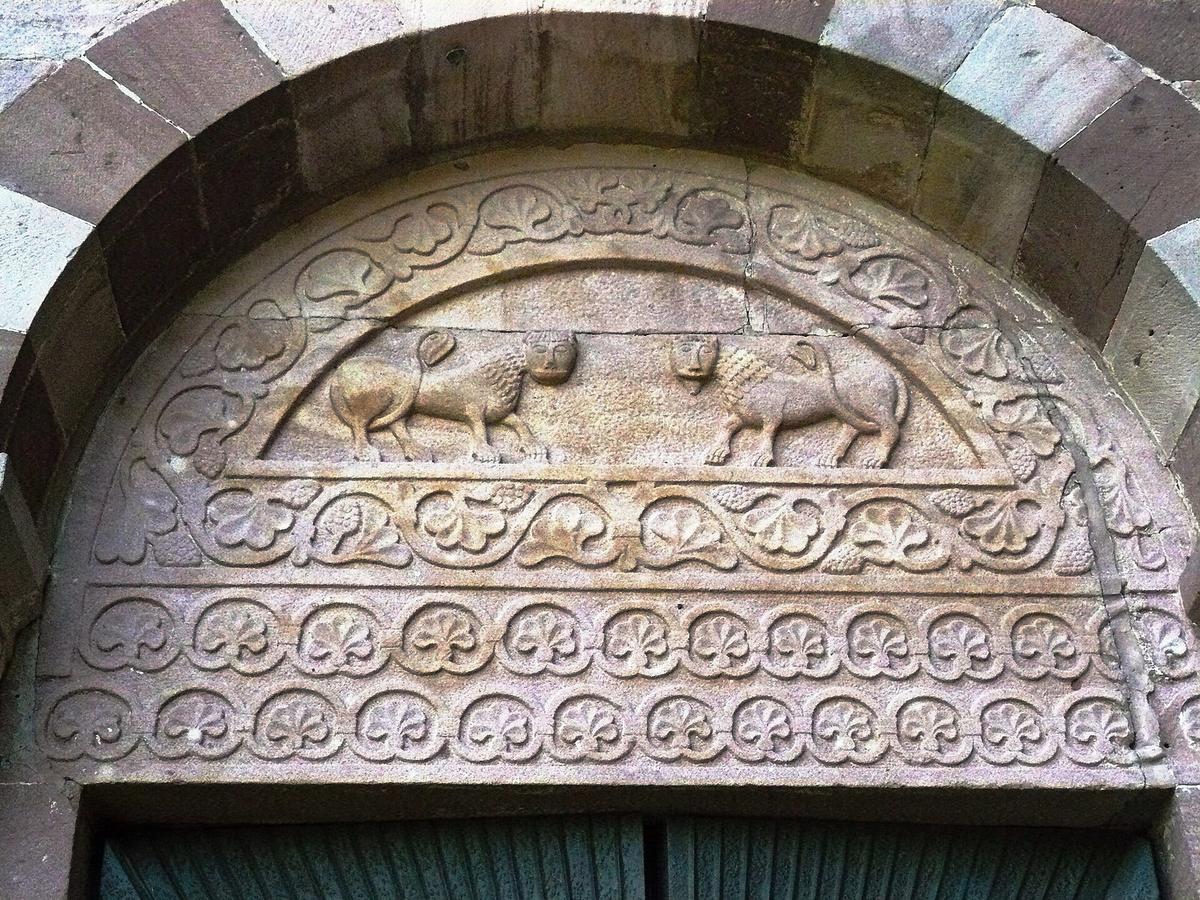

The south doorway and its lions. The tympanum over the south doorway shows two carved lions facing each other. Look closely: one of them is sticking its tongue out at visitors. It is the detail local guides point out first.
The Murbach dog. On the keystone of the entrance porch, you will see the arms of the prince-abbots: a silver greyhound, known as the "Murbach dog".
The tomb of Count Eberhard. Inside the church, a 13th-century effigy shows the founder of the abbey.
The sarcophagus of the martyred monks. A funerary slab, dated to the 10th and 11th centuries, recalls the seven monks killed, according to tradition, during the Hungarian raid.
The organ. It stands in the gallery. It was built in 1906 by the Alsatian organ builders Martin and Joseph Rinckenbach.
A modern curiosity. The village made the news in July 2024: its phone box, described as one of the last in service in France, received calls from all over the country after a newspaper article. It has been kept for emergency use.
The Loreto chapel and the Stations of the Cross
Above the abbey, on a wooded ledge, stands a small Baroque chapel. It was built in 1693 on the model of the Santa Casa in Loreto, Italy, the house of the Virgin Mary according to tradition. A sundial was added in 1714. It was fully restored in the late 1990s.
You reach it along Stations of the Cross with 14 stations, blessed in 1873. The climb is short but steep. It gives the best view of the abbey towers and the green valley, as the tourist office also recommends. Wear good shoes if the ground is wet.
Visiting Murbach Abbey with children
The church on its own will not hold young children for long. Two things make the difference.
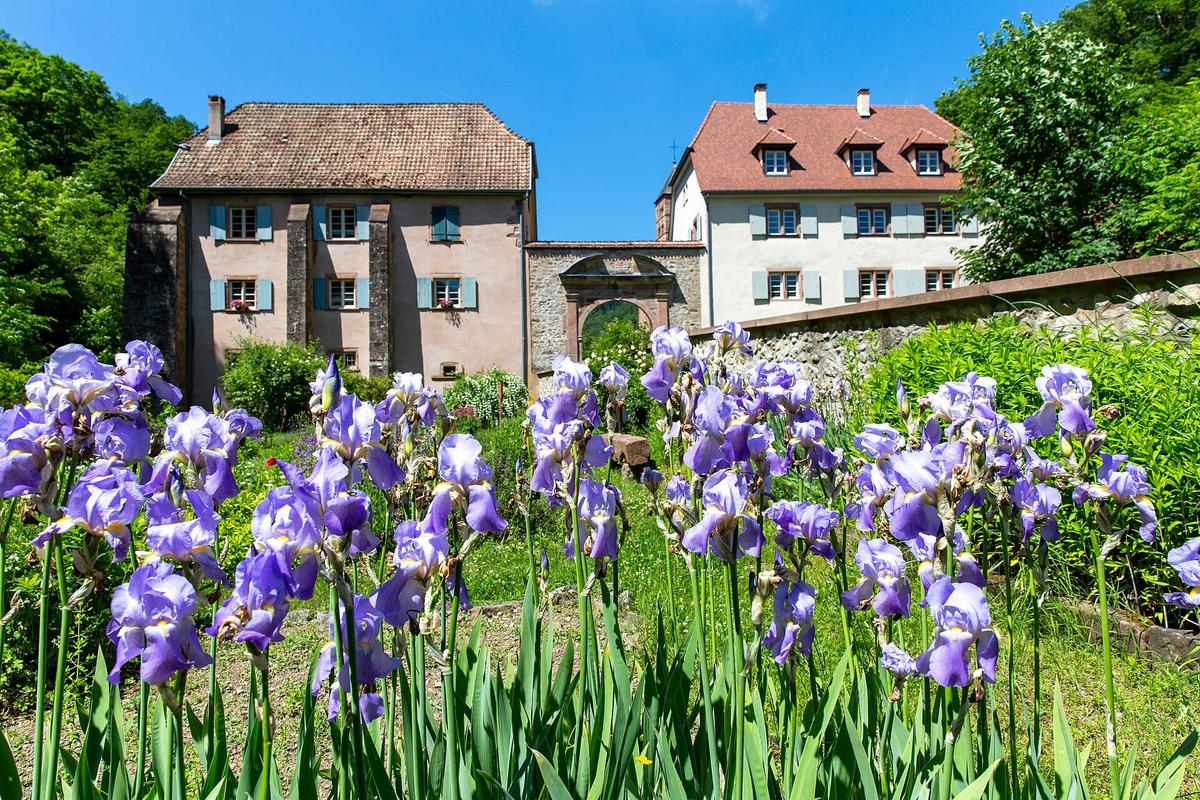

The mystery game. "Le secret volé de l'abbaye de Murbach" is an investigation game that takes players back to the 15th century. It is aimed at pre-teens, lasts about 2 hours and is played in teams of 1 to 4. The game bag costs €19. It is available from 1 April 2026 to 31 October 2026 at the Guebwiller tourist office, at the Auberge de l'Abbaye in Murbach and at a few other outlets in the valley.
The lion sticking its tongue out. Give them the mission of finding it on the south doorway before you go in.
The path to the Loreto chapel is fine for children who are good walkers, but not with a pushchair.
How to get to Murbach Abbey
By car. This is the easiest option. From Guebwiller, drive up the valley towards Buhl, then take the small D 40 II road to Murbach. The free car park is near the church. Allow 35 to 40 minutes from Colmar or Mulhouse.
Without a car. Guebwiller is the nearest town. The last stretch to Murbach is a small valley road with no convenient public transport, so check with the Guebwiller tourist office before you set off. The valley is also a hiking area, and Murbach is on several waymarked trails.
Renting a car. To combine Murbach with the Route des Crêtes, the Grand Ballon and the wine villages, a car hired in Mulhouse or Colmar is the most practical option.
What to see near Murbach Abbey on the same day
| Also worth seeing | Distance | Travel time |
|---|---|---|
| Écomusée d'Alsace | 20 km | 25 min by car |
| Unterlinden Museum | 35 km | 40 min by car |
| Cité de l'Automobile | 35 km | 35 min by car |
Approximate road distances and travel times.
The Écomusée d'Alsace at Ungersheim is about twenty minutes away: a reconstructed Alsatian village, ideal with children after a morning in Murbach. See also: Écomusée d'Alsace In Colmar, the Unterlinden Museum holds the Isenheim Altarpiece, painted for a convent a few kilometres from the Florival. See also: Unterlinden Museum In Mulhouse, the Cité de l'Automobile takes you to a completely different era. See also: Cité de l'Automobile
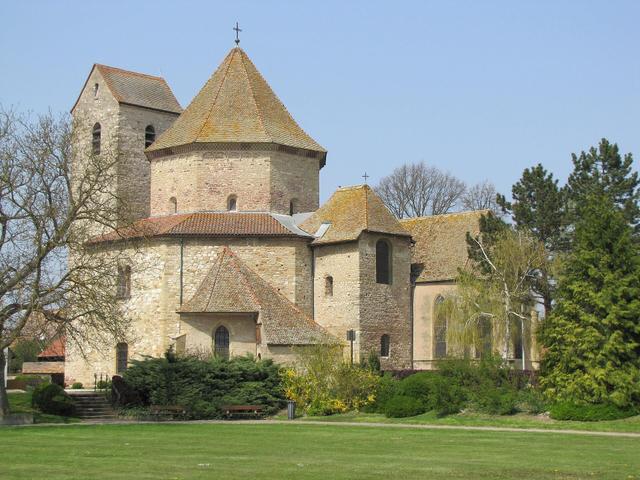
If Romanesque architecture is your thing, the octagonal abbey church of Ottmarsheim, near the Rhine, is the other great Romanesque church of southern Alsace. See also: Ottmarsheim Abbey Church Above Colmar, Hohlandsbourg Castle sits on a ridge of the Vosges. See also: Hohlandsbourg Castle, Mont Sainte-Odile, Marsal Salt Museum, Alsace
Where to eat and stay
In Murbach itself, the Auberge de l'Abbaye, listed by the tourist office, is a short walk from the church. For more choice, Guebwiller has restaurants, winstubs (traditional Alsatian wine taverns) and wine tasting: the town is on the Alsace Wine Route, with several grand cru vineyards.
To stay, Guebwiller is the most convenient base. The valley villages have holiday cottages and B&Bs, popular with walkers heading for the Grand Ballon.
Places to stay near Guebwiller
FAQ
Is Murbach Abbey free?
Yes, visiting the abbey church is free, and so is parking. Only the mystery game costs money, €19.
What are the opening hours of Murbach Abbey?
Tourist listings give opening hours of every day, 9:00 – 18:00. You cannot visit during services.
Why does Murbach Abbey have no nave?
The monks had it demolished in 1738 to build a Baroque church that never saw the light of day. A few years later they moved to Guebwiller.
Where is the lion sticking its tongue out?
On the tympanum of the church's south doorway, where two lions face each other.
How much time should I allow?
30 minutes for the church, an hour and a half with the climb to the Loreto chapel, about 2 hours with the mystery game.
Are there guided tours?
Yes. In summer, the tourist office runs free tours in German and in English, with booking recommended, and tours for groups by appointment.
Practical information
Official ticket-office prices 2026
Free admission
Address
Église Saint-Léger, 68530 Murbach, France
Directions · Phone+33 3 89 76 10 63
On site and nearby
- On site: Toilets
- Nearest shops and pharmacy: Buhl, 2 km away Straight-line distance, based on OpenStreetMap.
- Emergencies: 112 (all emergencies, free from any phone), 15 (SAMU, medical emergency)
Around the site, on Google Maps
With children
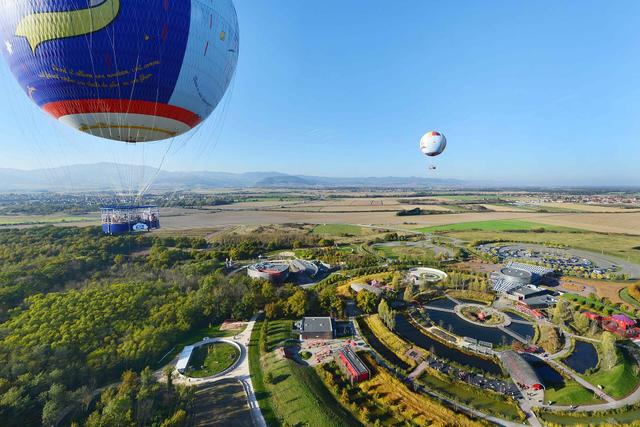
Family days out nearby: Écomusée d'Alsace (12 km), Parc du Petit Prince (12 km), Hohlandsbourg Castle (17 km)
Swimming pools and play areas nearby, on Google Maps
Facts checked on 12 November 2026. Sources: tourisme-guebwiller.fr, tourisme-eguisheim-rouffach.com, tourisme-guebwiller.fr, tourisme-guebwiller.fr, fr.wikipedia.org, fr.wikipedia.org, en.wikipedia.org, structurae.net, grand-est.developpement-durable.gouv.fr
Map
In the same region
- La Ferme aux Rennes (Reindeer Farm)from €7Free under 3