Ottmarsheim Abbey Church: visiting the octagonal church
Ottmarsheim Abbey Church at a glance
- Admission
- Free
- Where
- Ottmarsheim
Facts checked on 11 November 2026. Full opening hours, reduced prices and access
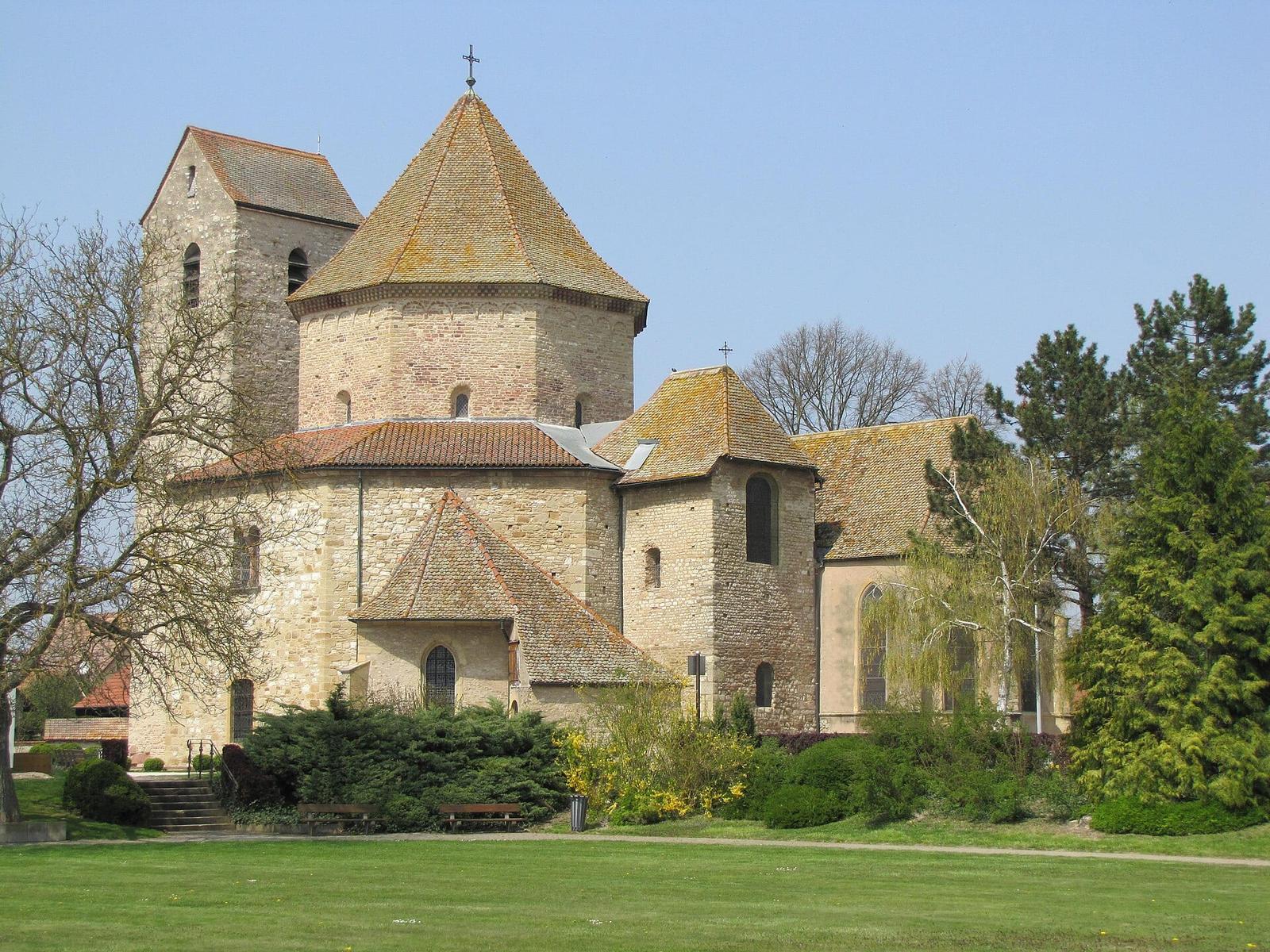

Near the Rhine, 14 km from Mulhouse, Ottmarsheim has a Romanesque church that is rare in France: an octagon built in the 11th century on the model of Charlemagne's chapel in Aachen. Consecrated by Pope Leo IX in 1049, it is the oldest church on Alsace's Romanesque Route. Entry is free. Here is what to look for, the opening hours, the guided tours and how to combine your visit with the museums of Mulhouse.
Ottmarsheim Abbey Church at a glance
- Where: in the centre of Ottmarsheim, Rue de l'Église, in the Haut-Rhin department, 14 km east of Mulhouse, close to the Rhine and the A36 motorway.
- Price: free entry. The costumed guided tours in summer cost €5.
- Open: every day, 8:30 – 19:00, according to the church's tourist listing.
- Time needed: 30 to 45 minutes for the church, an hour with a walk round the village.
- Best for: lovers of Romanesque art and history, and cyclists riding along the Rhine.
- Good to know: this is a parish church. Avoid service times when you visit.
Why visit Ottmarsheim Abbey Church
Because there is hardly anything else like it in France. The abbey church of Saints Peter and Paul has no long nave and no transept: it is an octagon, an eight-sided round church topped by a dome and surrounded by an upper gallery. Its plan copies that of the Palatine Chapel in Aachen, built for Charlemagne around 800.
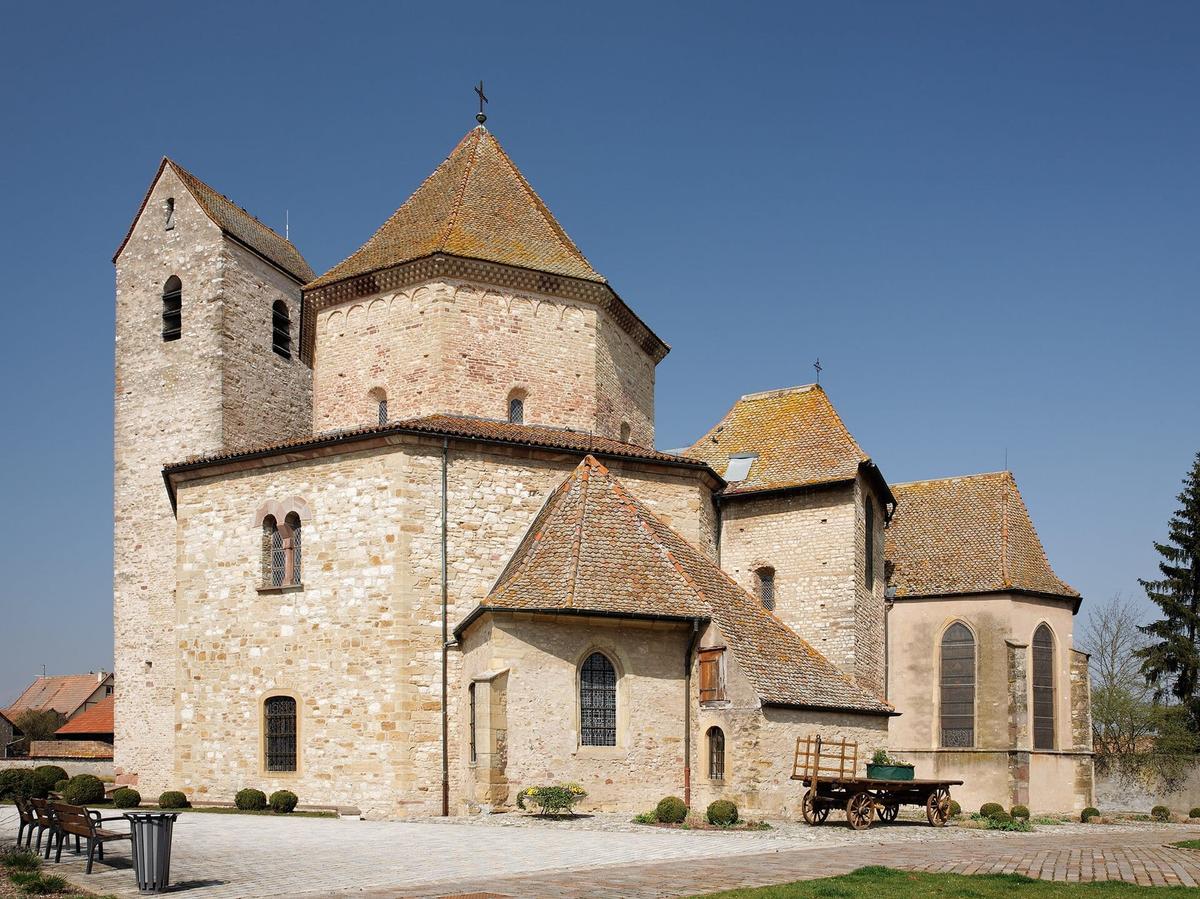

From the outside, the church looks massive and plain, in stone, with its square porch tower on the west side. Inside, the effect is quite different: you stand at the centre of a space that rises in one sweep to the dome, with the gallery arches all around. It is this volume, more than the furnishings, that makes the visit worthwhile.
The abbey church was listed as a historic monument by decree of 1 October 1841, one of the first protected buildings in France. Today it is the parish church of the village, which has 2054 inhabitants (2023).
History of the abbey church
Founded by the early Habsburgs. Around 1030, Count Rudolf of Altenburg had a convent for Benedictine nuns built on his lands. He belonged to the family that would later take the name Habsburg, the family of the future emperors of Austria. Choosing a plan copied from the imperial chapel in Aachen was no accident: it was a way of showing off the family's rank.

Consecrated by an Alsatian pope. In 1049, the church was consecrated by Pope Leo IX. Before becoming pope, he was called Bruno of Eguisheim and was born in Alsace.
Troubled centuries. The abbey stood on a busy route near the Rhine. In the 13th century, townspeople from Neuenburg, on the other bank, destroyed one of Count Rudolf's toll towers. In 1446, troops from Basel looted the abbey. The church survived the fire, but the soldiers carried off the miraculous image of the Virgin it held. Then came the Thirty Years' War, which hit the region hard.
From nuns to canonesses. Over time, the community became a chapter of canonesses, noblewomen who lived without taking permanent vows. In 1584 their number was set at 10. It was the abbesses who added the Gothic chapels: the south chapel around 1495, under Abbess Benigna of Dürckheim, then the canonesses' chapel, north of the choir, under Abbess Agnes of Dormentz. In 1603, the south chapel became the parish altar and received relics of the True Cross and the Crown of Thorns.
The French Revolution. In 1790, the chapter was dissolved. By then only the abbess and 6 canonesses remained. The abbey buildings were sold as national property and demolished by their buyers. Only the church survived, because it served the parish. The canonesses' choir stalls ended up in the church of Bantzenheim, the neighbouring village.
The 1991 fire and the restoration
This is the date local people remember. On the night of 27 to 28 February 1991, a fierce fire swept through the abbey church. The Baroque organ, built in 1726 and brought from Lucelle Abbey, was destroyed.

It was not the first restoration. As early as 1833, work had been carried out with the support of Prosper Mérimée, then inspector of historic monuments. A second campaign began in 1877, led by German architects at the time when Alsace was annexed. Back around 1765, the organ builder Silbermann had already noted large cracks on the south-west side.
After the fire, the work took several years and was completed in 1999. It uncovered frescoes from the 11th and 15th centuries. A new organ, in a Baroque-style case, was inaugurated in 2000.
A story about the bells. The church bells were requisitioned in 1917, during the First World War. They were replaced in 1924 by bells cast in Brest, then again in 1993, after the fire, by bells from Karlsruhe.
What to see inside the abbey church
Start by standing in the centre of the octagon and looking up. Then walk round the lower gallery before going to see the choir and the chapels.
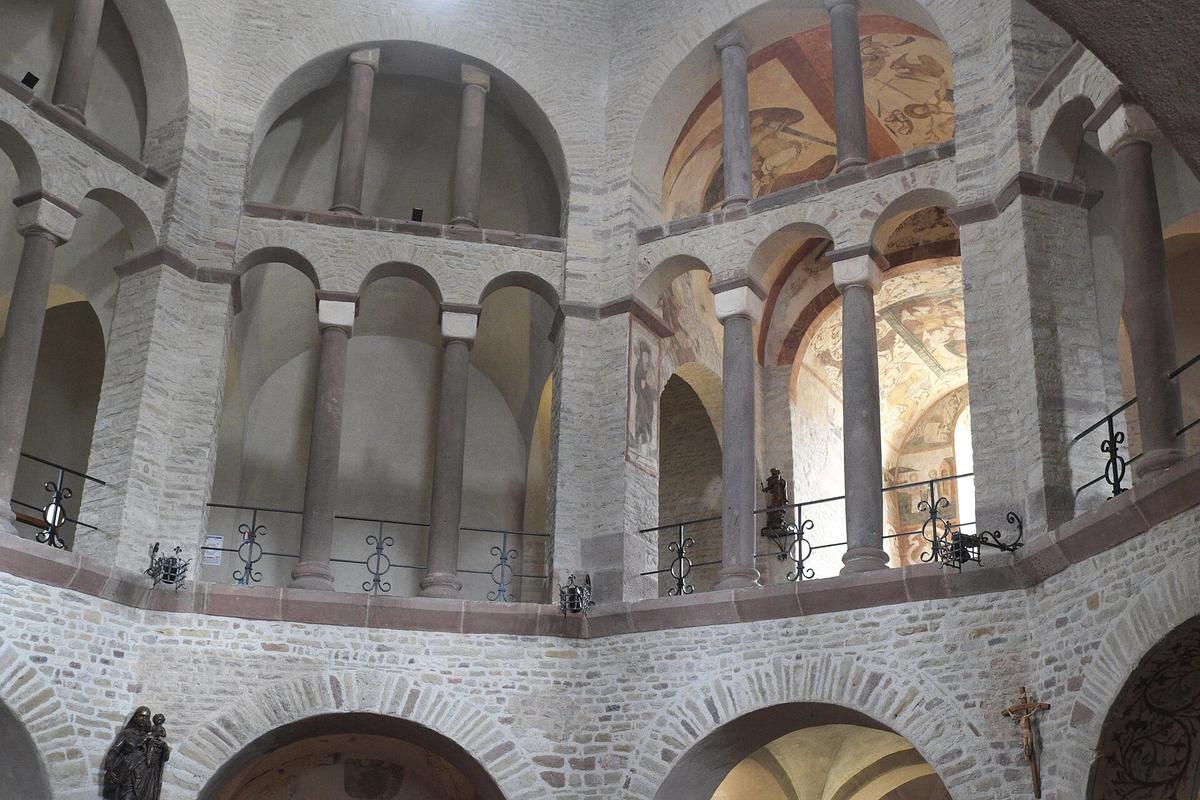

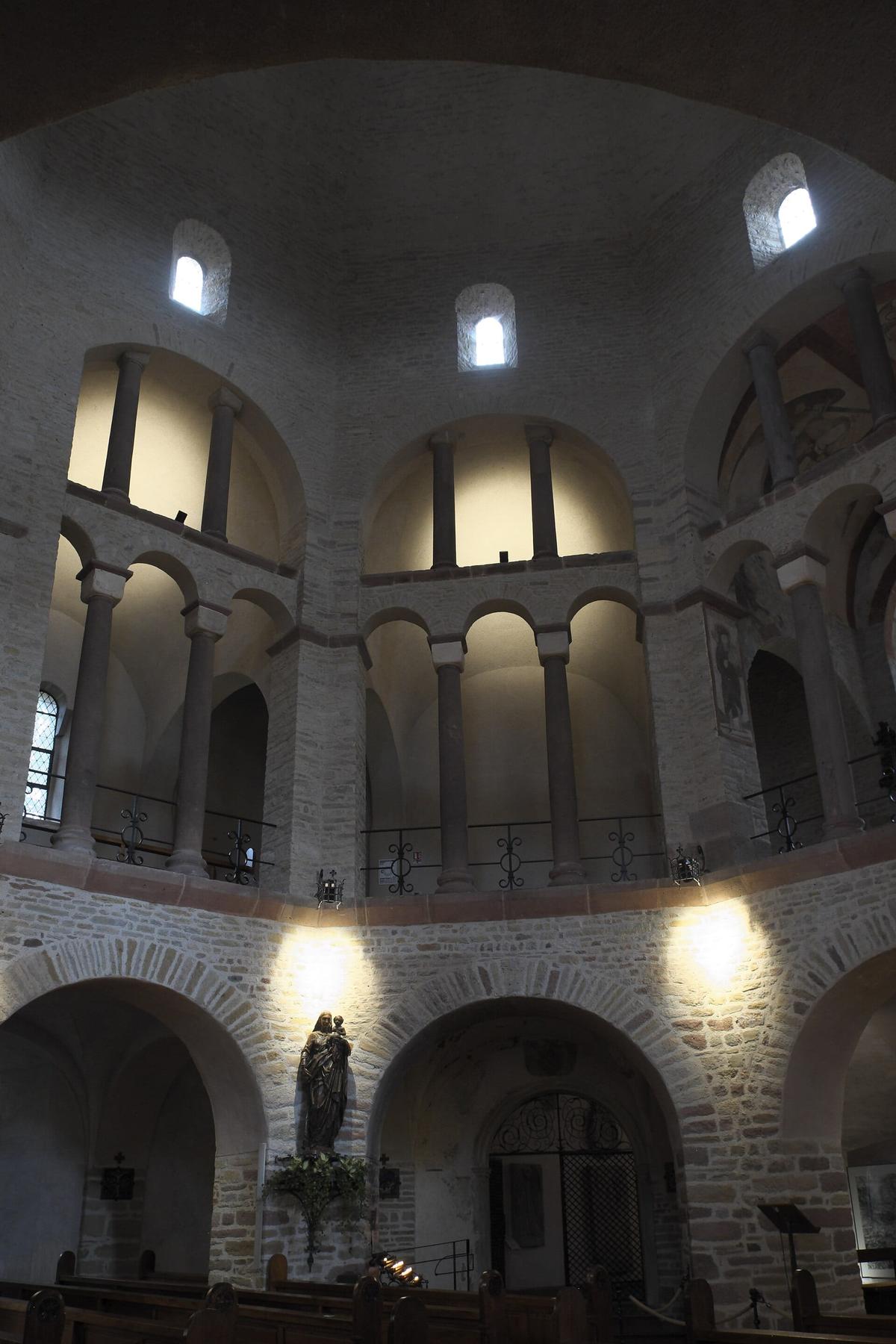
The octagon and the dome. Eight massive pillars carry arches on two levels. On the ground floor, an ambulatory runs round the central space. Above, the gallery opens through taller arches with columns. The dome closes it all off. If you know Aachen, the likeness is striking, only simpler and without the mosaics.
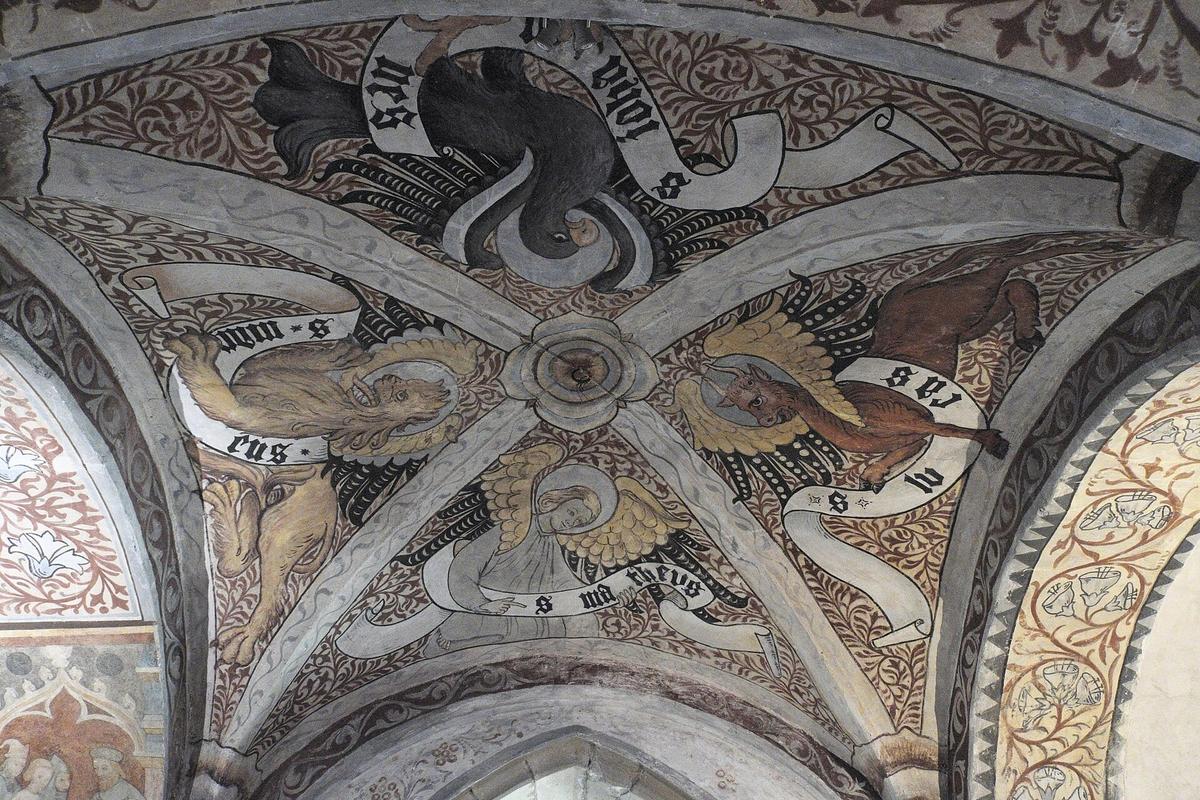
The frescoes. They were uncovered during the 1877 restoration, then during the work that followed the fire. The most visible ones are in the choir, dedicated to Saint Peter, at gallery level. According to the church's history, Abbess Elisabeth of Blumeneck had them painted around 1460. Look at them with binoculars or your phone's zoom: they are high up.
The Gothic chapels. They were added against the Romanesque octagon in the 15th and 16th centuries. Their style contrasts with the rest of the church and shows how the abbesses adapted the building to their needs.
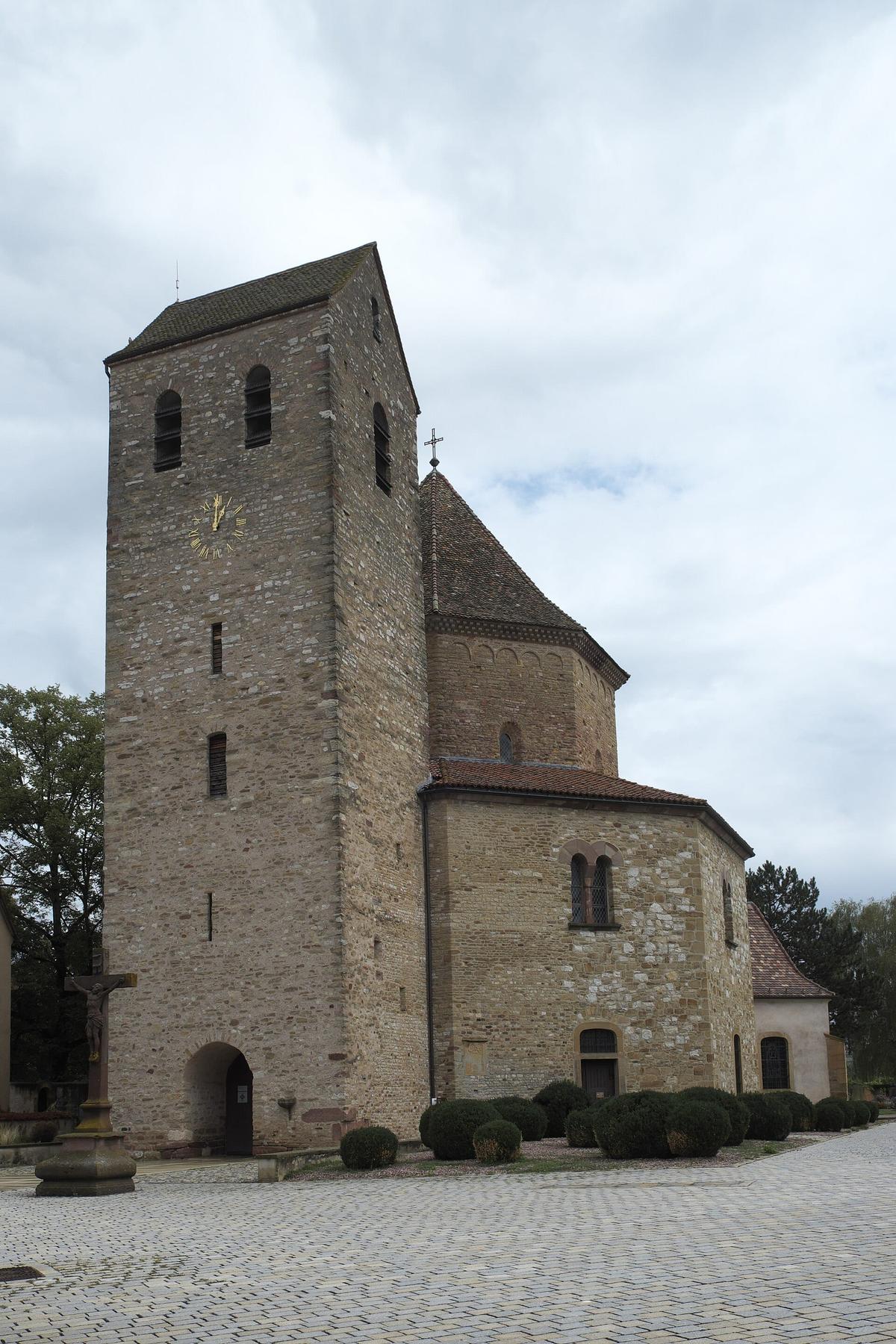
The porch tower. On the west side, it was a simple porch in the 11th century. It was raised in the 13th century to become the present bell tower.
The organ. The current instrument dates from 2000. Its case follows the Baroque style of the organ destroyed in 1991.
How much does it cost to visit?
Nothing. Entry to the abbey church is free, as the Alsace tourist board's listing confirms. There is no ticket and no booking for a self-guided visit.
The only paid visits are the costumed guided tours run in summer by the village heritage department: €5 per person in 2026.
Opening hours
According to the church's tourist listing, the abbey church is open every day, 8:30 – 19:00. It is a working church: during masses, weddings and funerals, you cannot visit. At weekends, early afternoon is the best time to come.
The village heritage department answers questions on +33 3 89 26 27 57. Hours may change in winter or during works, so a phone call before a long journey saves disappointment.
Guided tours and events
The Alsace tourist board says guided tours of the abbey church run all year round. For a group or a tour on request, contact the heritage department on +33 3 89 26 27 57 or by email at patrimoine@ottmarsheim.fr.

In 2026, the village offered two Sundays of events in summer:
- on 19 July 2026, a costumed tour at 16:30, followed by a free vibrational music concert at 18:00;
- on 23 August 2026, a free clay modelling workshop in the afternoon, then a costumed tour at 16:30.
Costumed tours must be booked in advance. For the European Heritage Days, the abbey church was open for self-guided visits on 19 September 2026. The following summer's programme is usually announced in spring: keep an eye on the village's events page and on the Journal des spectacles in Mulhouse.
No organised day trip makes a special stop at Ottmarsheim. Guided tours of Mulhouse are a good way to round off the day, though:
Partner links: if you book through these links, we earn a commission at no extra cost to you. Partner links · Learn more
How long does it take to visit?
Half an hour is enough to walk round the octagon and see the choir and the chapels. Allow 45 minutes if you take time to read the information panels and look at the frescoes. With a costumed tour, plan for an hour and a half. The abbey church is easy to combine with a museum in Mulhouse on the same day.
Visiting with kids
The visit is short and the shape of the church amuses children: count the eight sides, find the centre, look up at the dome while almost lying down. The summer costumed tours are the best way to get them interested in the story of the canonesses and the Habsburgs. For the rest of the day, the Cité de l'Automobile car museum and the Cité du Train railway museum in Mulhouse are two great family outings. See also: Cité de l'Automobile, Cité du Train
How to get to Ottmarsheim
By car. This is the easiest way. Ottmarsheim is 14 km east of Mulhouse, just off the A36 motorway that links Mulhouse with Germany. The abbey church is in the village centre, on Rue de l'Église.
By train. The nearest station is 17 km away, according to the Alsace tourist board. From Mulhouse, you will need a car, a bike or a taxi.
By bike. The abbey church is a well-known stop for cyclists following the Rhine. It has bike parking, and the tourist board mentions self-service repair tools (pump, puncture patches, tyre levers). There are also public toilets. It makes a handy break on the route between Basel and Strasbourg.
Renting a car. To link Ottmarsheim with the Mulhouse museums, Neuf-Brisach and the Wine Route on the same day, a car is still the simplest option.
What to see nearby on the same day
| Also worth seeing | Distance | Travel time |
|---|---|---|
| Cité de l'Automobile | 16 km | 20 min by car |
| Cité du Train | 19 km | 25 min by car |
| Neuf-Brisach | 30 km | 30 min by car |
Approximate road distances and travel times.
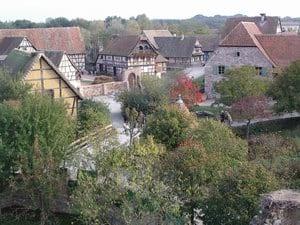
In Mulhouse, the Cité de l'Automobile shows the Schlumpf collection, one of the largest in the world, and the Cité du Train traces the history of the railways. See also: Cité de l'Automobile, Cité du Train North-west of Mulhouse, the Écomusée d'Alsace has rebuilt dozens of old Alsatian houses. See also: Écomusée d'Alsace
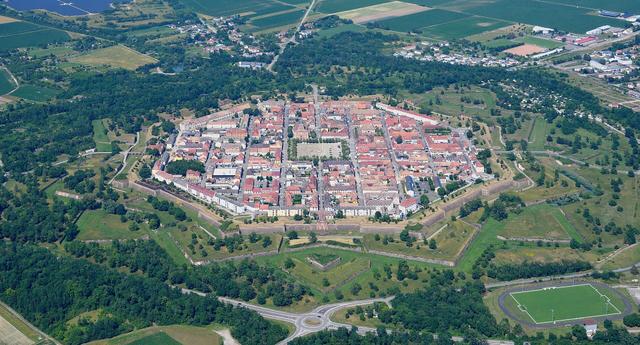
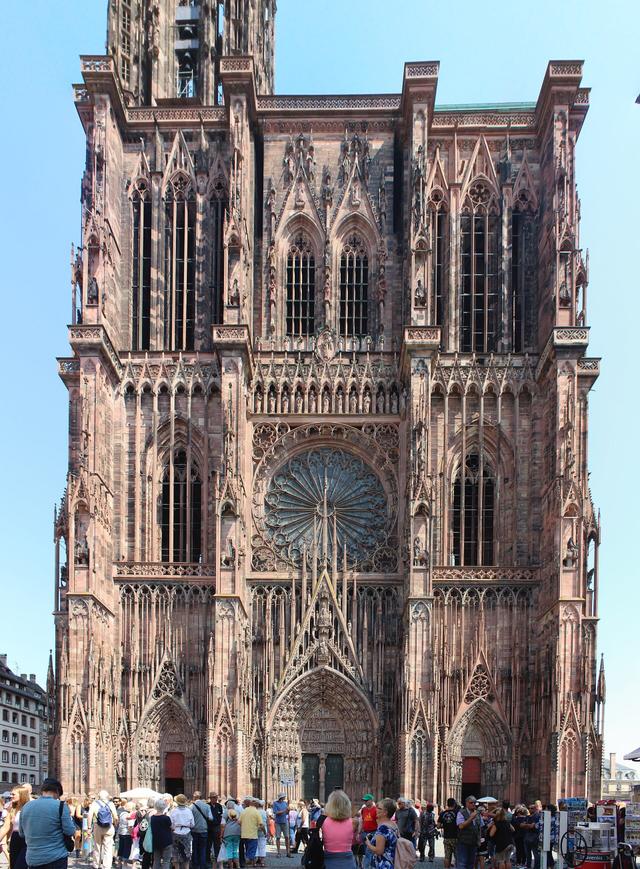
Heading north along the Rhine, Neuf-Brisach, the fortified town built by Vauban, is a UNESCO World Heritage Site. See also: Neuf-Brisach Further on, Colmar and the Unterlinden Museum, then the village of Riquewihr on the Wine Route, make a fine continuation of your trip. See also: Unterlinden Museum, Riquewihr If you like churches, Strasbourg Cathedral and Mont Sainte-Odile are the other two great religious sites in Alsace. See also: Strasbourg Cathedral, Mont Sainte-Odile, Alsace
Where to eat and stay near Ottmarsheim
Ottmarsheim is a village, so the choice of restaurants is limited, especially on Sunday evenings. For more options, Mulhouse is twenty minutes away.
For a place to stay, Mulhouse has the widest choice of hotels, near the station and the centre. It is also the most convenient base for combining the abbey church, the city's museums and the Écomusée d'Alsace. If you are cycling along the Rhine, look instead for a B&B in the villages between Ottmarsheim and Neuf-Brisach.
FAQ
Is Ottmarsheim Abbey Church free to visit?
Yes, entry is free. Only the summer costumed tours charge (€5).
Why is Ottmarsheim Abbey Church octagonal?
It copies the Palatine Chapel in Aachen, built for Charlemagne. Its founders, ancestors of the Habsburgs, wanted to show their rank with this imperial model.
Who consecrated the abbey church?
Pope Leo IX, born in Alsace as Bruno of Eguisheim, in 1049.
Did the abbey church burn down?
Yes, on the night of 27 to 28 February 1991. The Baroque organ was destroyed. The restoration was completed in 1999 and a new organ was inaugurated in 2000.
What are the opening hours of the abbey church?
It is open every day, 8:30 – 19:00, outside service times.
How do I get to Ottmarsheim from Mulhouse?
By car on the A36, in about twenty minutes for 14 km. There is no station in the village.
Practical information
Official ticket-office prices 2026
Free admission
Address
Rue de l'Église, 68490 Ottmarsheim, France
Directions · Phone+33 3 89 26 27 57
On site and nearby
- On site: Toilets
- Nearest shops and pharmacy: Ottmarsheim, less than 1 km away Straight-line distance, based on OpenStreetMap.
- Emergencies: 112 (all emergencies, free from any phone), 15 (SAMU, medical emergency)
Around the site, on Google Maps
With children
Family days out nearby: Cité de l'Automobile (14 km), Cité du Train (17 km), Écomusée d'Alsace (18 km)
Swimming pools and play areas nearby, on Google Maps
Facts checked on 11 November 2026. Sources: visit.alsace, guide-tourisme-france.com, jds.fr, techno-science.net, pop.culture.gouv.fr, en.wikipedia.org
Map
In the same region
- La Ferme aux Rennes (Reindeer Farm)from €7Free under 3