Guimiliau Parish Close: planning your visit
Guimiliau Parish Close at a glance
- Admission
- Free
- Time needed
- about 1 h
- Where
- Guimiliau
Facts checked on 11 November 2026. Full opening hours, reduced prices and access
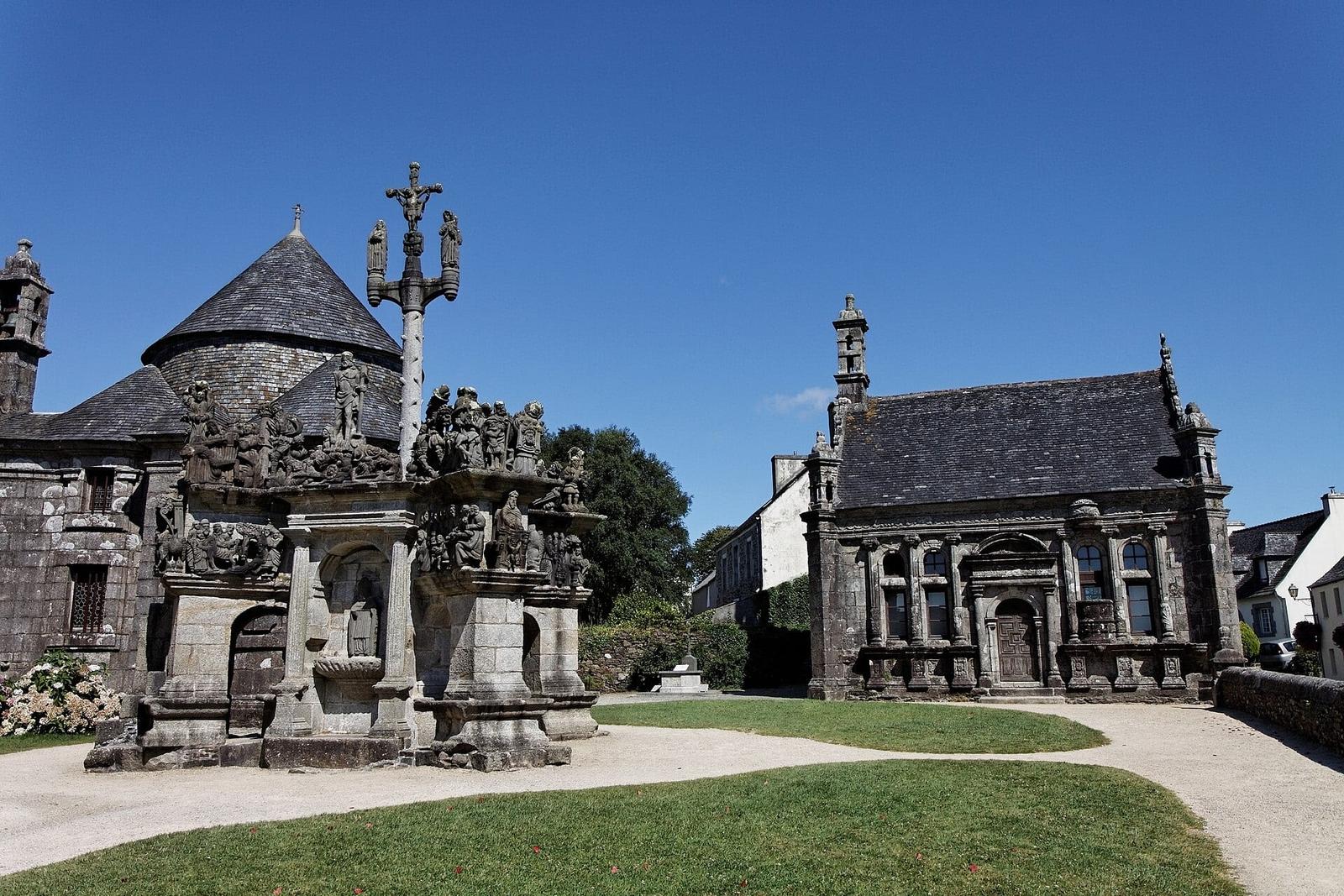

In a small village in the Léon area, between Landivisiau and Morlaix, the Guimiliau parish close brings together one of the most crowded calvaries in Brittany, a porch lined with apostles and a church with almost intact Baroque furnishings. Here are the opening hours, what to look for, the legend of Katell Gollet and our tips for making the most of it.
Guimiliau Parish Close at a glance
- Where: in the centre of the village of Guimiliau (Finistère), 7 km from Landivisiau and about twenty kilometres from Morlaix.
- Price: entry is free, both to the close and to the church.
- Open: the Landivisiau tourist office lists the parish closes as open every day, 9:00 – 19:00.
- Time needed: allow about 60 minutes for the calvary, the porch, the church and the chapel; half an hour more for the nearby interpretation centre.
- Best for: lovers of religious art and sculpture, anyone curious about Breton history, travellers following the parish close circuit.
- Good to know: the church of Saint-Miliau is a place of worship. During masses and funerals, wait outside.
What is a parish close?
A parish close (enclos paroissial) is a group of religious buildings enclosed by a wall at the heart of a village. You enter through a monumental gateway, often called the triumphal arch. Inside are the church, the calvary, the ossuary (where bones removed from the graveyard were kept) and, in the past, the graveyard itself. The wall separates the sacred space from the rest of the village.

Parish closes are a speciality of Lower Brittany, and above all of the Léon, in the north of Finistère. Most were built in the 16th and 17th centuries, when parishes grew rich from the linen cloth trade. Neighbouring villages competed for the finest porch, the tallest steeple or the richest calvary. Guimiliau, Lampaul-Guimiliau and Saint-Thégonnec, a few kilometres apart, are the three most visited closes on this circuit.
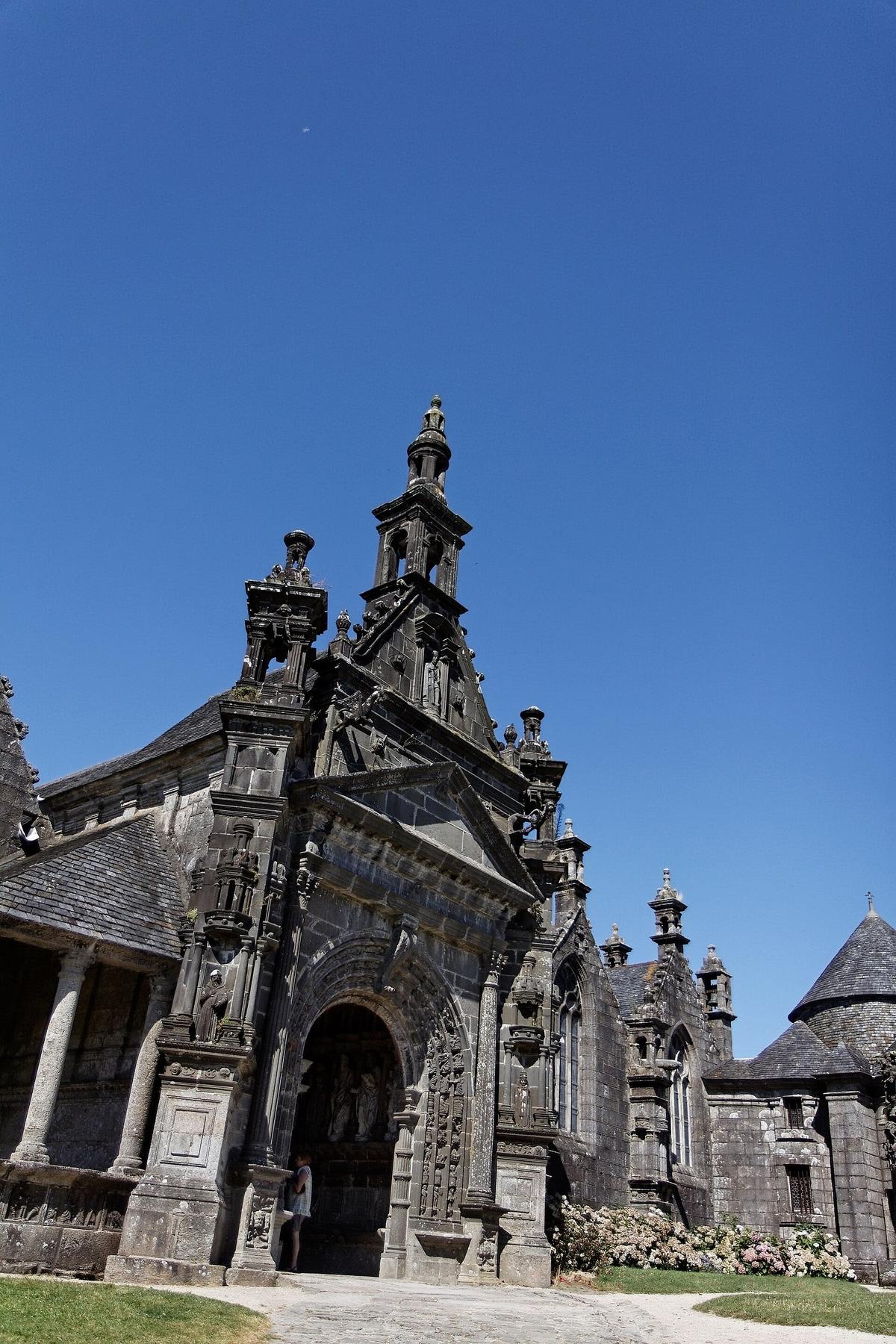
Guimiliau's close is complete: triumphal arch, calvary, church, porch and a former ossuary turned into a chapel. The church, the chapel and the calvary have been listed as historic monuments since 21 May 1906, and the triumphal arch since 1914.
How much does it cost? Is the parish close free?
Yes. The close and the church of Saint-Miliau are free to visit. There is no ticket office and no booking. A donation in the church offering box helps the parish look after the furnishings.
The "Les Enclos" interpretation centre, a short walk away, presents the heritage of the parish closes in the area. In August 2026, it hosted "YS", a photography exhibition by Benjamin Deroche, free to visit.
The Landivisiau tourist office hands out a free map of the parish close circuit, by car or by bike. Ask for it before you set off: it saves hunting for the churches along country roads.
Partner links: if you book through these links, we earn a commission at no extra cost to you. Partner links · Learn more
Guimiliau Parish Close opening hours
For the 2026 season, the tourist office says the closes of Commana, Guimiliau, Lampaul-Guimiliau, Locmélar and Sizun are open every day, 9:00 – 19:00. The close itself, with its calvary, can still be seen from the street outside these hours.
The "Les Enclos" interpretation centre is at 53 Rue du Calvaire. In August 2026, it was open Monday to Saturday, 9:30 – 12:30 and 14:00 – 18:00, and closed on Sundays. Hours vary from month to month: call the tourist office (+33 2 98 68 33 33) before coming out of season.
Our tip: come in the morning, between 9 and 10 am, or late in the day. Tour coaches mostly arrive mid-morning and early afternoon in summer. The calvary is carved in kersanton, a dark stone: the low light of morning or evening brings out the faces far better than the midday sun.
What to see at Guimiliau Parish Close

The calvary and its 200-plus figures
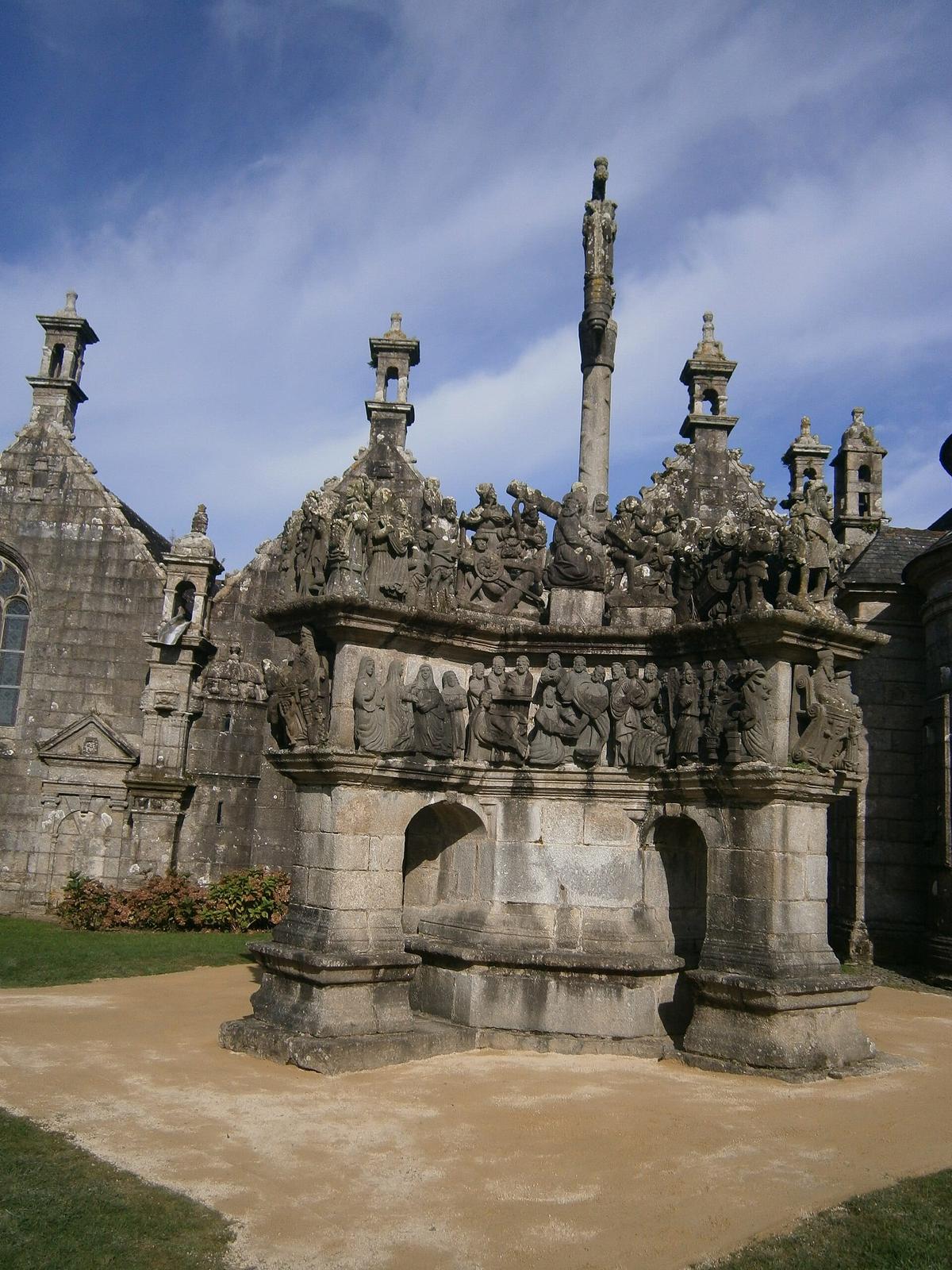
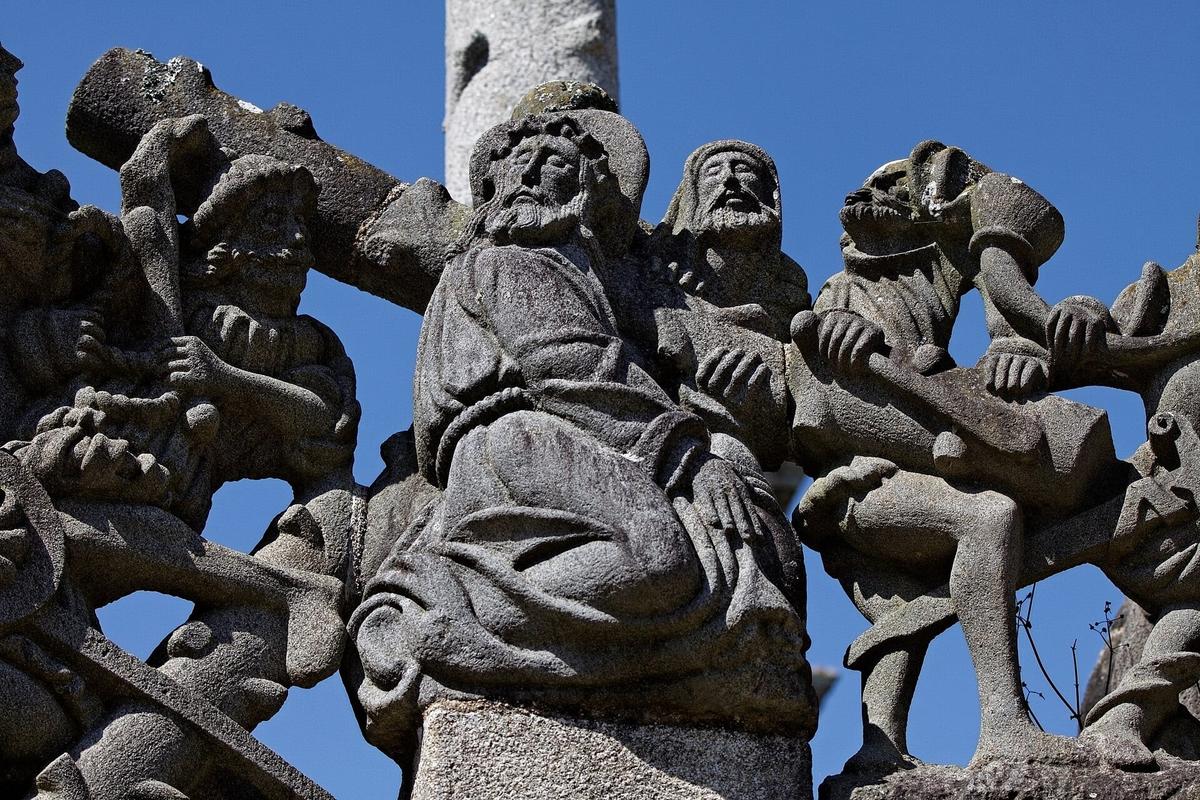
This is the centrepiece of the close. The calvary was carved from 1581 to 1588: the date 1581 is carved above the altar, and 1588 below the Adoration of the Magi. According to the Brittany heritage inventory, it has more than 200 figures carved in kersanton, on an octagonal base. Figures vary between sources, since it all depends on how you count the people in each scene.
The four evangelists stand at the corners of the base. All around, a frieze tells the life of Christ, from childhood to the Passion, with a realism that often amuses visitors: the costumes are those of the late 16th century, not of ancient Palestine. Take the time to walk all the way round, then step back to see the central cross and its statues.
The legend of Katell Gollet. On the calvary, one scene shows a young woman being dragged by demons into the jaws of hell. This is Katell Gollet, "Catherine the lost". According to the legend, she hid a sin in confession out of love for a handsome dancer, who was in fact the devil. Priests used this image to remind parishioners to confess everything.
The triumphal arch and the plague cross
You enter the close through a wide arched gateway, topped by a curved pediment and statues of horsemen. Inside the close stands a plague cross too, a reminder of the epidemics that struck the parish.
The south porch and its apostles
The porch was built between 1606 and 1617. Both dates are carved in the stone: 1606 on the west wall, inside, and 1617 near the keystone. Historians attribute most of the decoration to the Master of Plougastel, with finishing work by the sculptor Roland Doré.
Look up at the arches: three rows of small scenes tell stories from the Old and New Testaments, mixed with scenes of everyday life. Inside the porch, the twelve apostles stand in their niches, as in most of the great porches of the Léon.
Saint-Miliau church and its furnishings
The church was built in the 16th and 17th centuries. The bell tower, attributed to the Beaumanoir workshop, is the oldest part (first half of the 16th century). The north facade bears the date 1633, the east end 1664 and the sacristy 1683.
Inside, the 17th-century furnishings have survived almost complete, which is rare:
- The baptistery. At the west end of the south aisle. The font is dated 1675. It is covered by a carved oak canopy carried on 8 twisted columns. It is the most photographed feature.
- The pulpit. It bears the date 1677; the staircase was rebuilt in 1747.
- The organ loft. The organ case dates from the late 17th century. The organ is attributed to the organ builder Thomas Dallam (1677 according to the diocese of Quimper) and was rebuilt by Koenig in 1937.
- The altarpieces. The church has 3, all from the 17th century: the Rosary altarpiece to the north, those of Saint Miliau and Saint Joseph to the south.
On the Saint Miliau altarpiece, one panel shows the saint carrying his own head. According to tradition, Miliau was a Breton prince beheaded in 792 on his brother's orders. People prayed to him against ulcers and rheumatism.
Saint Anne's chapel, the former ossuary
To the left of the porch, the old ossuary has become a chapel. It bears the inscription of the year 1648. Notice the outdoor pulpit attached to its facade: the priest preached from it in the open air to parishioners gathered in the close, especially at funerals. The chapel was first dedicated to Saint Roch, protector against the plague, then to Saint Anne.
How long does it take to visit?
One hour is enough to see the calvary, the porch, the church and the chapel properly without rushing. Add half an hour for the interpretation centre. If you are doing the circuit of the three great closes (Guimiliau, Lampaul-Guimiliau, Saint-Thégonnec), allow half a day, including driving time.
Guimiliau, Lampaul-Guimiliau or Saint-Thégonnec: which one to choose?
If you only have time for one close, Guimiliau is the most often recommended for its calvary, the most crowded with figures in the area. Lampaul-Guimiliau, 3 km away, stands out more for the very colourful interior of its church and its rood beam. Saint-Thégonnec impresses with its sheer size. All three are free and close together: the best option is to do them one after the other in the same morning.

Two stories worth knowing
Closes paid for by linen. Guimiliau's wealth came from flax. In the 16th and 17th centuries, the farmer-merchants of the Léon wove linen cloth and sold it as far afield as England and Spain. The parish councils invested that money in stone, which explains why such a small village has such a rich ensemble.
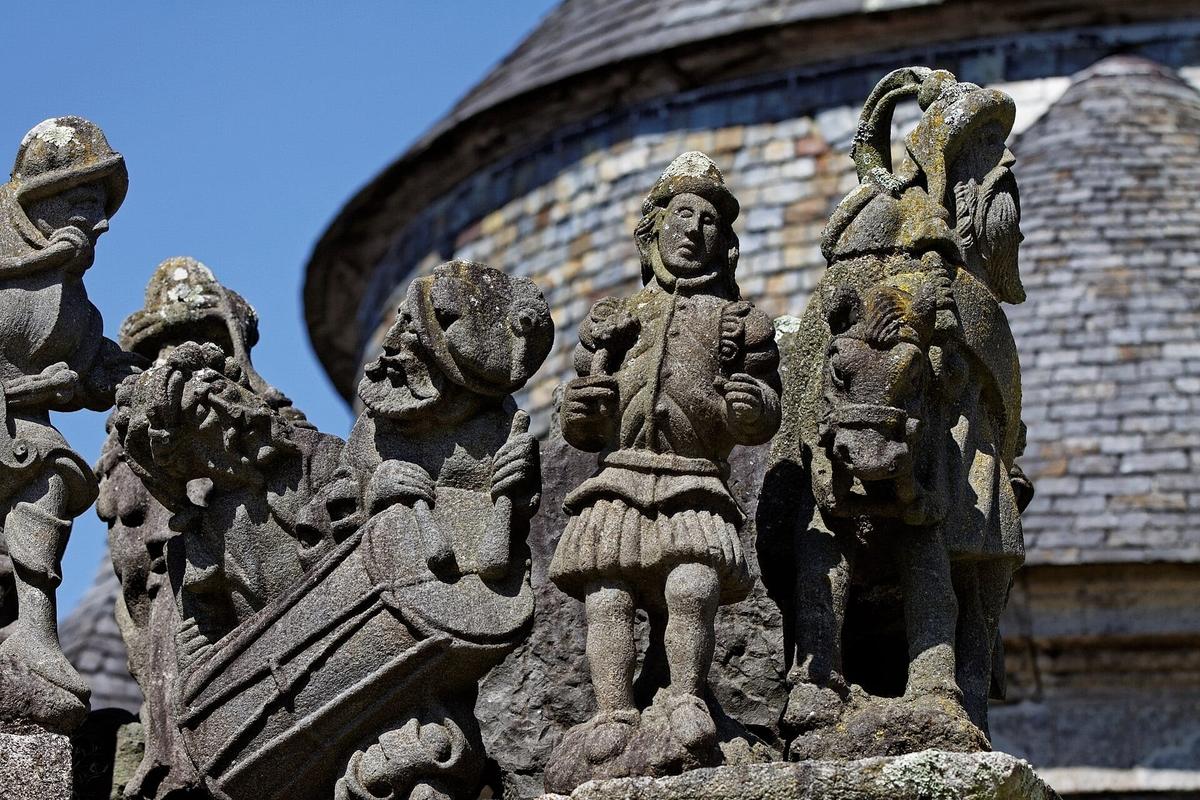

A calvary not designed to be admired. The calvary was first and foremost a teaching tool. Priests used it to tell the Gospel to worshippers who could not read, scene by scene, walking round the base. That is why the episodes follow in order, like a comic strip in stone.
Visiting with kids
The visit is short, free and mostly outdoors, which makes it easy with children. Turn the calvary into a treasure hunt: find Katell Gollet and the demons, count the soldiers of the Passion, spot the four evangelists and their symbols (the angel, the lion, the ox, the eagle). In the church, show them the twisted columns of the baptistery. Keep your voices down: it is a place of prayer.

How to get to Guimiliau Parish Close
By car. This is the simplest option. Guimiliau is a few minutes from the N12 dual carriageway (Brest to Morlaix), Landivisiau exit. Allow about 25 minutes from Morlaix and 45 minutes from Brest. Park in the village, at the foot of the close.
By train. Landivisiau station, on the TER regional line between Brest and Morlaix, is 7 km away. From there you need a taxi or a bike.
By bike. The 18 km parish close cycle circuit passes through Guimiliau. The tourist office provides it free on request.
Renting a car. To link the parish closes, Kerjean Castle and the Bay of Morlaix, a car is essential. Brest airport and Morlaix station are the most convenient arrival points.
What to see nearby on the same day
| Also worth seeing | Distance | Travel time |
|---|---|---|
| Château de Kerjean | 20 km | 25 min by car |
| Cairn of Barnenez | 30 km | 35 min by car |
| Landévennec Abbey | 65 km | 55 min by car |
Approximate road distances and travel times.
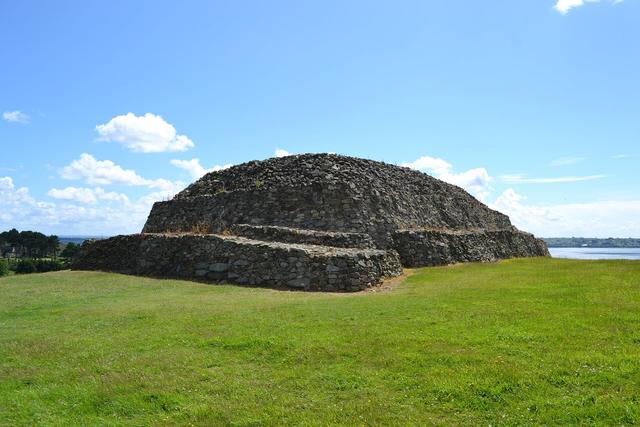
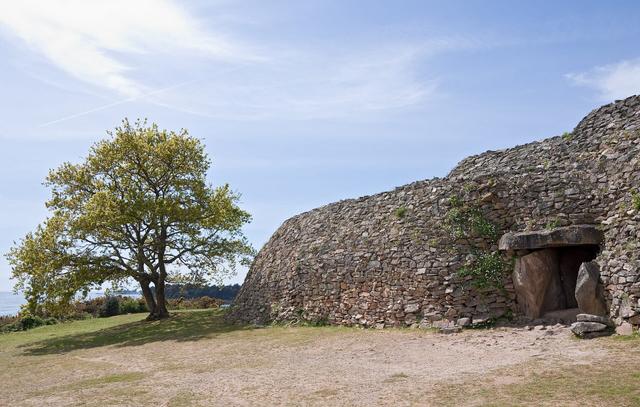
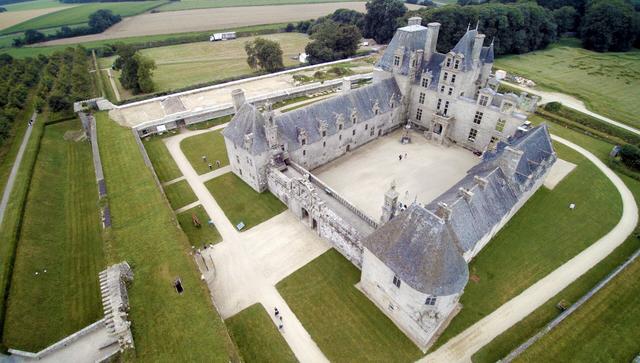
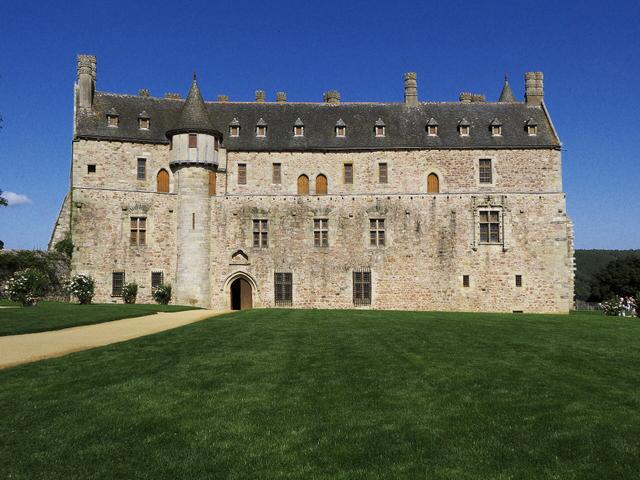
Start with the neighbouring closes of Lampaul-Guimiliau and Saint-Thégonnec. North of Landivisiau, Kerjean Castle, the great Renaissance mansion of the Léon, is less than half an hour away. See also: Château de Kerjean Towards the Bay of Morlaix, the Barnenez Cairn shows a far older heritage, more than six thousand years old. See also: Cairn of Barnenez
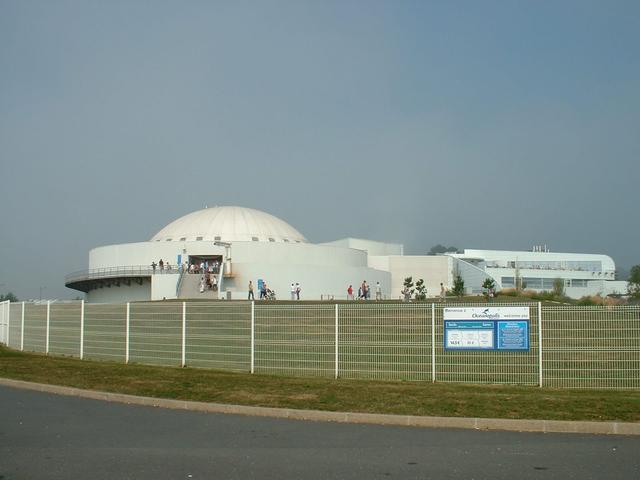
Further south, the Crozon peninsula and Landévennec Abbey round off a trip devoted to Breton religious heritage. See also: Landévennec Abbey For another great church in Finistère, Quimper Cathedral is just over an hour away. See also: Quimper Cathedral (Saint-Corentin) With children, Océanopolis in Brest makes a good stop. See also: Océanopolis Brest, Brittany
Where to eat and stay
Guimiliau is a small village: for lunch, Landivisiau and Saint-Thégonnec have more choice (crêperies, restaurants). A picnic before or after the visit is an easy option in fine weather.
For a place to stay, Landivisiau is the nearest base, in the middle of the parish close circuit. Morlaix, about twenty minutes away, has more hotels and makes a good base for the bay and Roscoff.
Places to stay near Landivisiau
FAQ
Do you have to pay to visit Guimiliau Parish Close?
No. The close and the church are free to visit, with no booking.
How many figures are there on the Guimiliau calvary?
More than 200 according to the Brittany heritage inventory, carved in kersanton between 1581 and 1588.
What are the opening hours of Guimiliau Parish Close?
For the 2026 season, the tourist office lists it as open every day, 9:00 – 19:00.
Who is Katell Gollet?
A young woman from Breton legend, damned for hiding a sin in confession. The calvary shows her being dragged into hell by demons.
How long does it take to visit Guimiliau?
About an hour for the close and the church, half a day for the circuit of the three great neighbouring closes.
Can you visit the church during mass?
You can attend, but not look around: wait until the service is over before walking through the church.
Practical information
Official ticket-office prices 2026
Free admission
Address
Enclos paroissial, 1 rue de l'Église, 29400 Guimiliau, France
Directions · Phone+33 2 98 68 33 33
On site and nearby
- Nearest shops and pharmacy: Saint-Thégonnec, 6 km away Straight-line distance, based on OpenStreetMap.
- Emergencies: 112 (all emergencies, free from any phone), 15 (SAMU, medical emergency)
Around the site, on Google Maps
With children
Family days out nearby: Château de Kerjean (14 km), Daoulas Abbey (24 km), Landévennec Abbey (30 km)
Swimming pools and play areas nearby, on Google Maps
Facts checked on 11 November 2026. Sources: roscoff-tourisme.com, relecture.patrimoine.bzh, diocese-quimper.fr, en.wikipedia.org, pop.culture.gouv.fr
Map
In the same region