Pont du Gard: planning your visit
Pont du Gard at a glance
- Admission
- Free
- Free
- under 18s
- Visitors per year
- about 1,400,000 (2011)
- Where
- Vers-Pont-du-Gard
Facts checked on 29 October 2026. Full opening hours, reduced prices and access
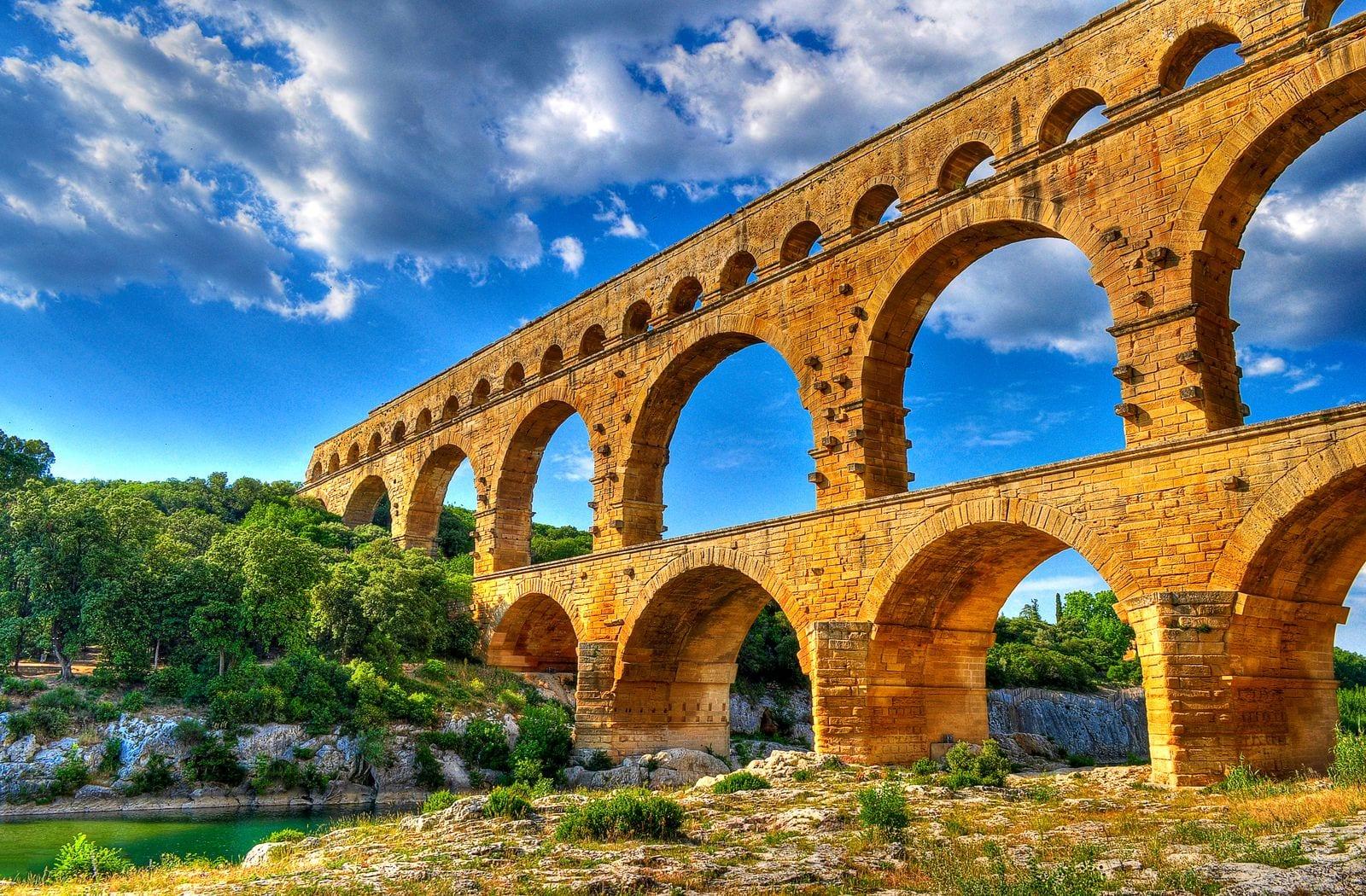
The Pont du Gard carried a Roman aqueduct almost 50 m above the Gardon river. You can walk across it, swim beneath it or paddle up to it by canoe. Access to the bridge is free: you pay for parking, and for the museum only if you want to see it. It is in the Gard department, 25 km from Avignon, and we list it with Provence because almost everyone visits it from Avignon or Nîmes. Here is how to go about it.
Pont du Gard at a glance
- Where: at Vers-Pont-du-Gard, in the Gard, 25 km from Avignon and 27 km from Nîmes.
- Price: free access to the bridge. Parking is €9 per car per day, however many people are inside. On foot or by bike, you pay nothing.
- Museum and discovery areas: €8 per adult, free for under-18s.
- Open: the site and car parks every day, 8:00 – 0:00. The museum is closed from November to February.
- Time needed: two hours for the bridge and museum, a full day in summer with a swim.
- Getting there: by car via the A9 motorway, or by coach from Avignon (line 115) or Nîmes (line 121).
Partner links: if you book through these links, we earn a commission at no extra cost to you. Partner links · Learn more
Understanding the Pont du Gard
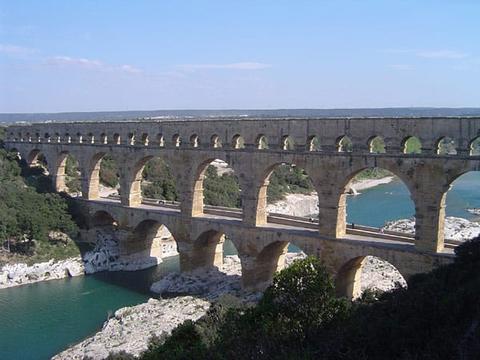
The Pont du Gard is only one piece of a much longer structure. It is part of an aqueduct about 50 km long that carried water from a spring near Uzès to Nîmes, the Roman city of Nemausus. The water flowed by gravity alone, with an average gradient of 25 cm per kilometre. Around 35,000 m³ arrived every day for the city's fountains and baths.
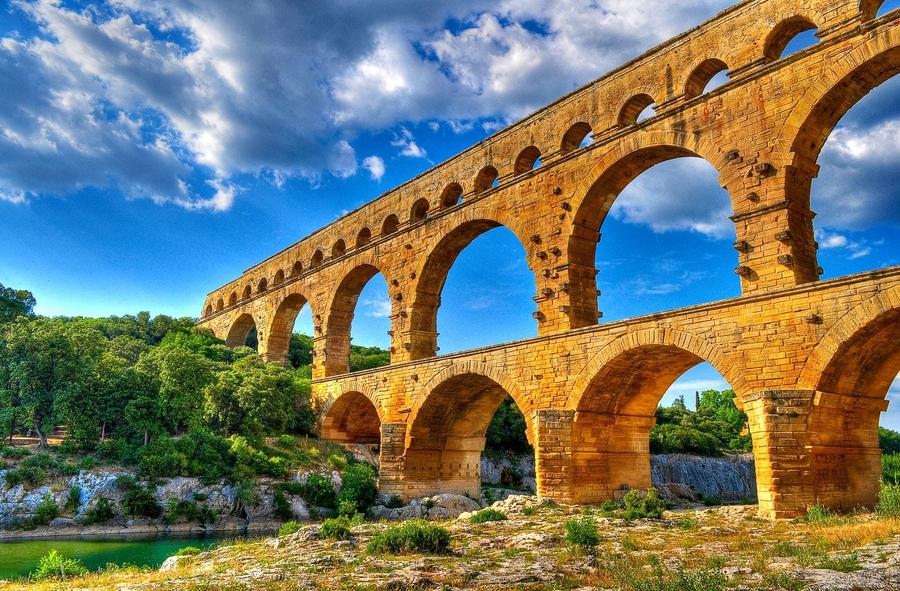
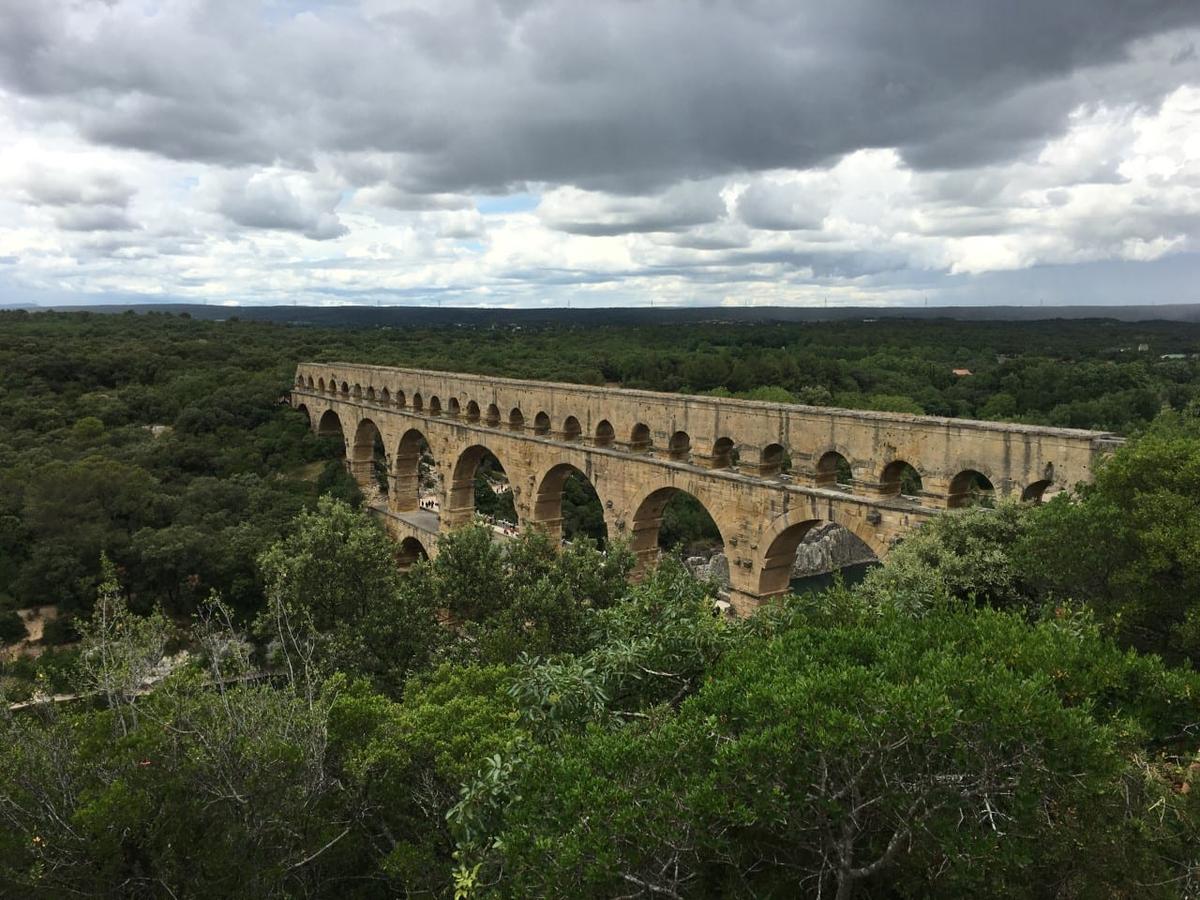
To cross the Gardon valley, Roman engineers built three tiers of arches, one on top of the other. The water channel runs along the very top, on the third tier. The bridge rises 48.77 m above the river at low water, making it the tallest known Roman bridge. It probably dates from around AD 40 to 50. The stones are laid without mortar, and some blocks weigh up to 6 tonnes.
The bridge has been a UNESCO World Heritage Site since 1985. Since the site was redeveloped in the early 2000s, it has been open to pedestrians only.
Pont du Gard prices: what is free and what you pay for
The system has changed and many online guides are out of date. Today, access to the bridge and the trails is free. Three things cost money: parking, the discovery areas (museum, cinema, Ludo children's area, temporary exhibition) and guided tours.
- Parking: €9 per car for the day, whatever the number of passengers. You pay on site, at the pay machines or by card at the exit barrier.
- On foot or by bike: nothing to pay to reach the bridge.
- Discovery areas: €8 per adult, €6 for jobseekers and people on RSA income support. Free for under-18s, students and disabled visitors.
- Guided tour: €15 per adult, €6 per child aged 4 to 17, discovery areas included. Places are limited.
- Audio guide: €4 per person, in €8 languages.
Tickets for the discovery areas and guided tours are valid for the date and time you choose. They cannot be exchanged or refunded.
Our tip: if you plan to come back, keep your parking ticket. Within 14 days, it can be turned into an annual pass at no extra cost by creating an account online. And if you arrive on a liO regional train, your train ticket gets you a reduced rate: €6 for a self-guided visit, €13 for a guided tour.
Do you need to book?
For the bridge alone, no: access is free. For guided tours, yes in summer, as places are limited and it is the only way to walk inside the water channel at the top of the bridge. The tour ends on top of the structure, on the third tier. This level is not wheelchair accessible (80 steps and scrubland paths).
Tour operators also run day trips that combine the Pont du Gard with Avignon, Nîmes or the villages of the Luberon.
Partner links: if you book through these links, we earn a commission at no extra cost to you. Partner links · Learn more
Pont du Gard opening hours and best time to visit
The bridge and the car parks are open every day, 8:00 – 0:00. Parking after midnight is not allowed and you will be fined.
The cultural areas (museum, cinema, Ludo area) follow a different calendar:
- March and October: 9 am to 6 pm.
- April, May, June and September: 9 am to 7 pm.
- July and August: 9 am to 8 pm.
- November to February: closed.
They are closed on Monday mornings for maintenance. The ticket office closes half an hour before the areas do, and the site advises arriving at least 50 minutes before closing.
Our tip: in July and August, come at opening time or late in the afternoon. The low evening light turns the stone ochre, the heat drops and the car parks empty. In winter, the museum is closed but the bridge stays open and the site is almost deserted: the best time for photos.
What to see at the Pont du Gard
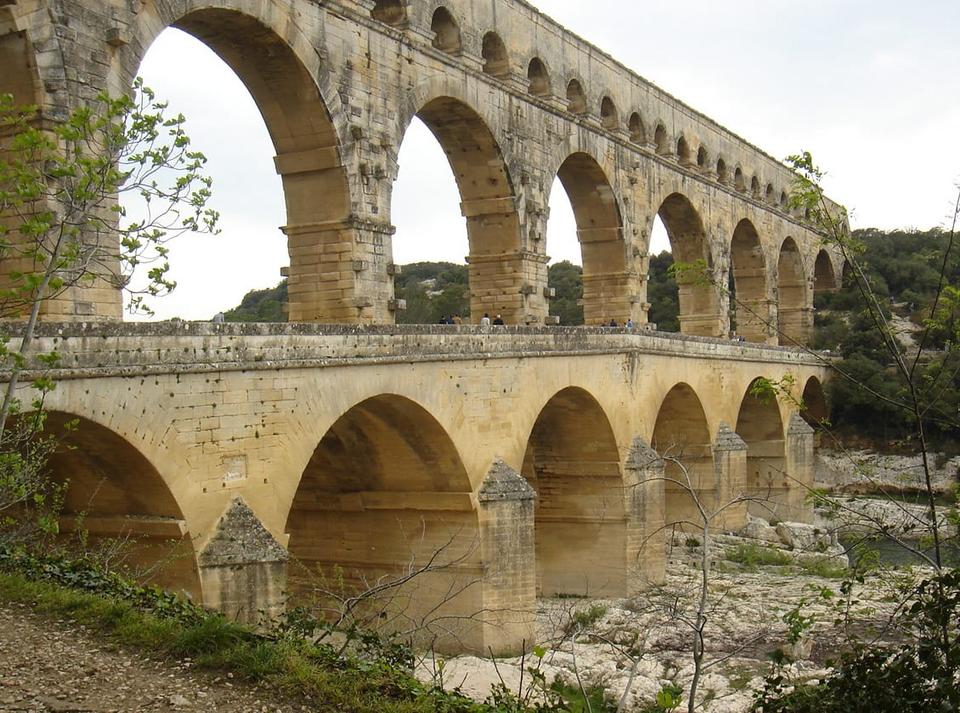
The bridge itself. Three tiers of arches: 6 at the bottom, 11 in the middle and 35 at the top. The top tier is now 275 m long; it was 360 m originally, before twelve arches were lost. You cross on the road bridge built against the first tier in the 18th century. Look at the stones: they carry Roman assembly marks and hundreds of graffiti left over the centuries.
The museum. Covering 2500 m², it explains the Roman building site, the water's route to Nîmes and life in the ancient city. The cinema shows a 15-minute film. The exhibition includes things to touch and listen to. The museum and the restaurant have lifts.
The two banks. The left bank has the large car park, the museum and most of the facilities. The right bank has the second car park and the clearest views of the upstream face of the bridge. Cross at least once in each direction: the two sides look quite different.
The Mémoires de Garrigue trail. A 1.4 km loop across 15 hectares, among olive trees, dry-stone walls and old farmland. The trail is not accessible to visitors with reduced mobility. It gets very hot in summer afternoons, so walk it in the morning.
The thousand-year-old olive trees. Near the bridge, three olive trees around a thousand years old were replanted in 1988. They come from a valley in Spain.
Swimming and canoeing at the Pont du Gard
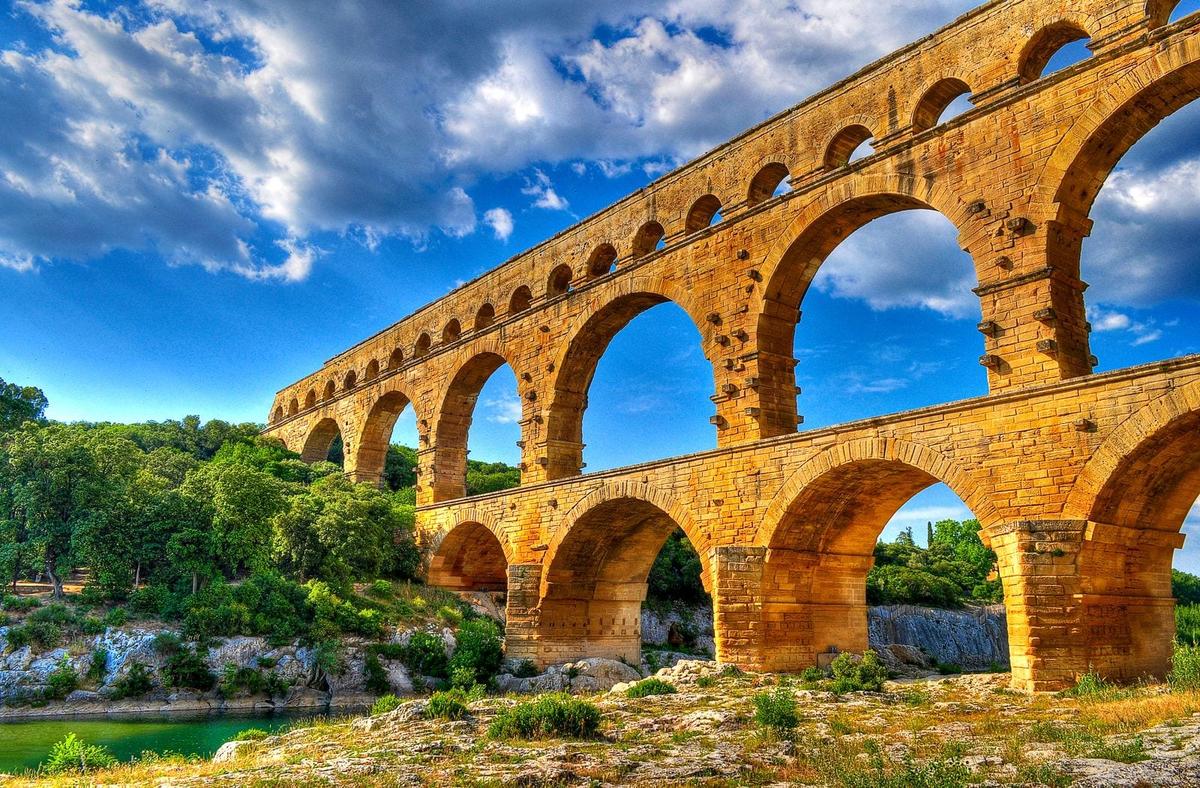
Swimming. You can swim in the Gardon at the foot of the bridge. The season runs from April to September. There is no lifeguard: watch your children yourself, and do not swim after a storm, when the river rises fast. The Gardon is prone to flash floods: in September 2002, the water reached three quarters of the way up the lower arches. Bring water shoes for walking on the rocks.
Canoeing. Paddling down the Gardon is the most spectacular way to reach the bridge: you drift right under the arches. Canoe hire companies are in Collias, a few kilometres upstream, and in Remoulins. At Kayak Vert, for example, the 2026 season ran from 4 April 2026 to 19 October 2026, with routes of 8 to 30 km depending on the time of year and return shuttles every half hour. Canoeing is not allowed for children under 6 or for anyone who cannot swim.
Our tip: leave your car at the finish point in Collias and take the hire company's shuttle. You will not have to go back for the car at the end of the day.
How long does it take to visit the Pont du Gard?
Allow an hour to walk along both banks and cross the bridge. Add an hour for the museum and the film. With the Mémoires de Garrigue trail, a swim or a canoe trip, the site easily fills a whole day. The parking ticket is valid all day, so make the most of it.
Visiting the Pont du Gard with children
This is one of the best family days out in the region. Entry to the discovery areas is free for under-18s, and parking costs the same whatever the size of your family.
The Ludo area, included in the discovery areas ticket, is designed for children aged 5 to 12. The cinema film is short (15 minutes). Then come the swim and the picnic by the Gardon, which are often what children remember best.
With little ones, keep a few things in mind: the beach has no lifeguard, the rocks are slippery, and the path to the top of the bridge, open only on guided tours, has a lot of steps.
Visiting the Pont du Gard in a wheelchair
The car parks have reserved spaces and the main paths are easy to use. The site lends wheelchairs free of charge. The cultural areas and Les Terrasses restaurant have lifts, and entry to the discovery areas is free for disabled visitors. The third tier of the bridge and the Mémoires de Garrigue trail are not accessible.
How to get to the Pont du Gard
By car. The bridge is close to the A9 motorway, exit 23 (Remoulins), then the road to Uzès. Signs point to the left bank (rive gauche) or right bank (rive droite). The left bank car park has 800 spaces, the right bank one 600. Electric car charging points are available in the left bank car park.
By coach from Avignon. Line 115 on the liO regional network links Avignon to the Pont du Gard (it continues to Alès). This is the easiest option if you are staying in Avignon without a car. Check the timetable before you set off, especially for the return in the late afternoon.
By coach from Nîmes. Line 121 leaves from Nîmes. From Paris, the TGV takes about 2 h 50 to Nîmes; Nîmes and Avignon are the nearest stations to the site. Coming from the UK, you can take the Eurostar to Paris and change there.
By bike. The greenway from Beaucaire to Uzès (32 km) runs right into the site. From Avignon, the ViaRhôna cycle route takes you to Beaucaire.
Renting a car. The coach is fine for the bridge alone. To combine it with Uzès, the Gardon gorges or Arles on the same day, a car picked up in Avignon is more practical.
What to visit near the Pont du Gard on the same day
| Also worth seeing | Distance | Travel time |
|---|---|---|
| Pont d'Avignon (Pont Saint-Bénezet) | 25 km | 30 min by car |
| Palais des Papes | 25 km | 30 min by car |
| Arles Amphitheatre | 45 km | 45 min by car |
Approximate road distances and travel times.
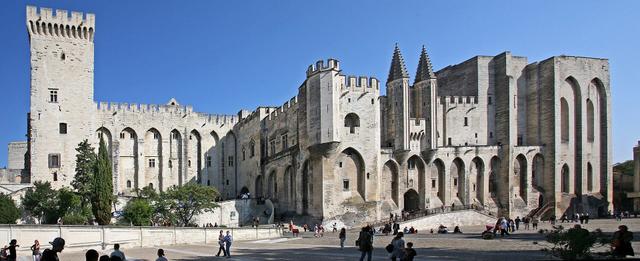
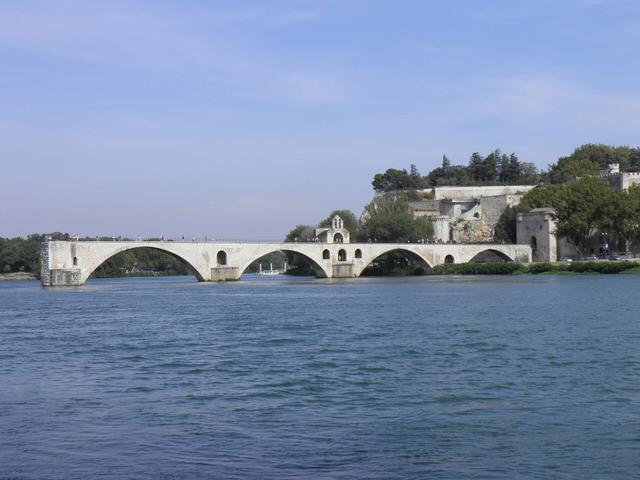
Avignon. 25 km away, the Palais des Papes and the Pont Saint-Bénezet are best visited in the morning, before heading to the Pont du Gard for the afternoon and a swim. See also: Palais des Papes, Pont d'Avignon (Pont Saint-Bénezet)
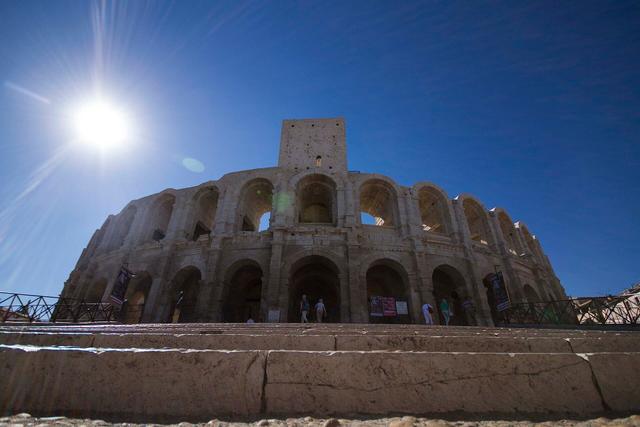
Arles. The amphitheatre and the Roman theatre in Arles round off a Roman-themed day. See also: Arles Amphitheatre
Orange. The Roman theatre in Orange, north of Avignon, still has its Roman stage wall. See also: Roman Theatre of Orange
To plan your trip: See also: Provence
Facts and figures
- About 1,400,000 visitors in 2011, making it one of the most visited ancient monuments in France.
- A road bridge stuck to the Roman one. In 1747, the engineer Henri Pitot built a road bridge against the first tier. Cars used it until the site was reserved for pedestrians.
- Centuries of graffiti. The Compagnons du Tour de France, travelling craftsmen, left more than 320 marks on the stones. The oldest dates from 1611.
- Saved by Napoleon III. From 1855 to 1859, the emperor had the structure restored after centuries of stone theft.
- A banknote lookalike. The bridge on the back of the 5 euro note is an imaginary design, but it looks a lot like the Pont du Gard.
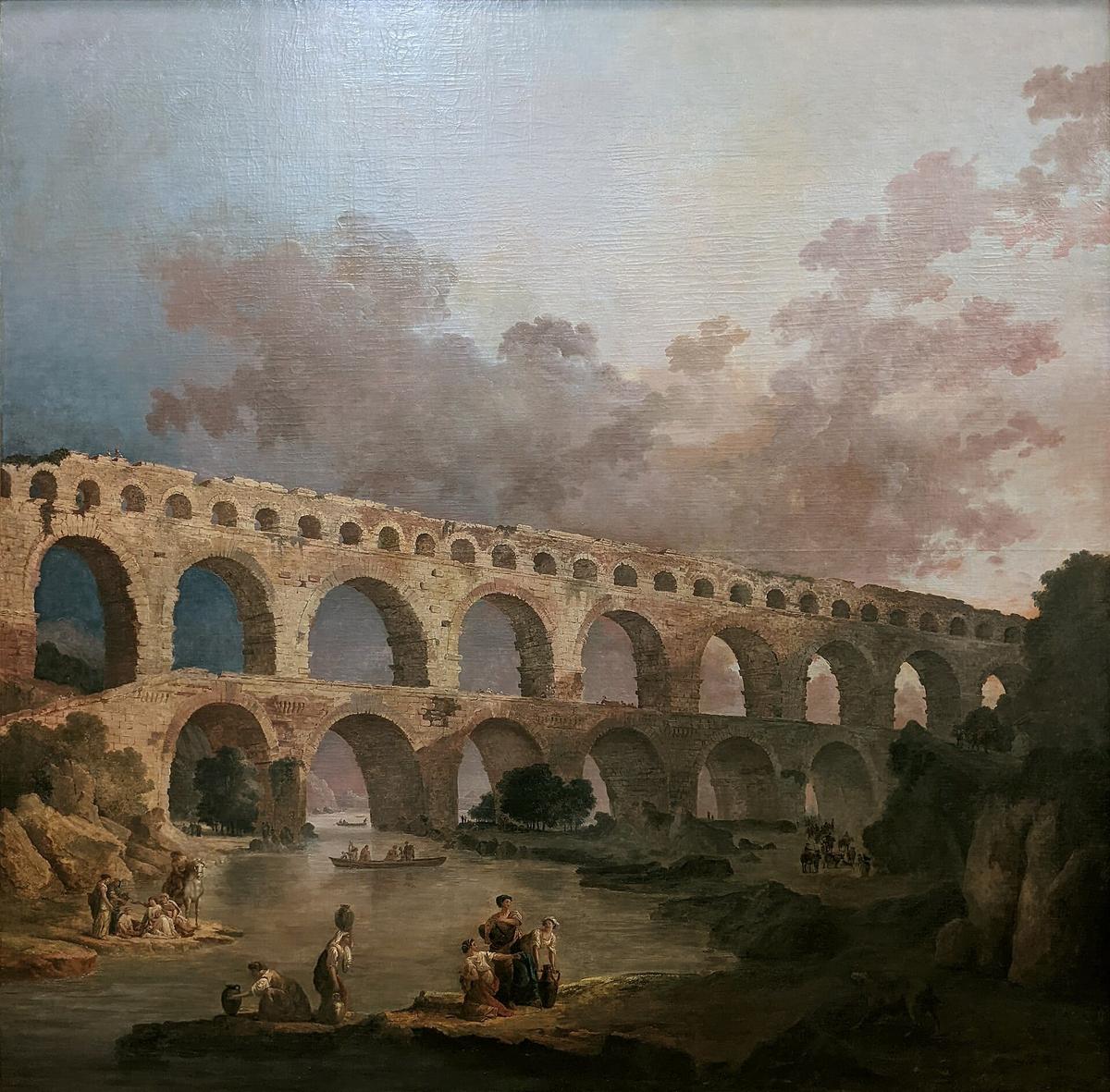
- Painted by Hubert Robert. The painter depicted the bridge in 1787; the painting now hangs in the Louvre.
Where to eat and stay near the Pont du Gard
On site. Les Terrasses restaurant and the Bistro on the left bank serve lunch. In summer, many families picnic on the riverbanks: bring water, as shady spots fill up fast.
Nearby. Uzès, about twenty minutes away, has restaurants around its Place aux Herbes. Remoulins and Castillon-du-Gard are the nearest villages.
Where to stay. Without a car, stay in Avignon: the coach leaves from the city and the rest of Provence is within reach by train. With a car, Uzès or the villages around the bridge are quieter.
FAQ
Is the Pont du Gard free to visit?
Yes, access to the bridge and the trails is free. You pay for parking (€9 per car per day) and, if you wish, the museum (€8 per adult, free for under-18s).
Can you swim at the Pont du Gard?
Yes, in the Gardon at the foot of the bridge, from April to September. There is no lifeguard.
Can you walk on top of the Pont du Gard?
Only on a guided tour, which goes through the water channel and ends at the top. The road bridge on the first tier is open to everyone.
How do I get to the Pont du Gard without a car?
By liO coach: line 115 from Avignon, line 121 from Nîmes. By bike, along the greenway from Beaucaire to Uzès.
Is the Pont du Gard open in winter?
The bridge and car parks are, every day, 8:00 – 0:00. The museum and cultural areas close from November to February.
How much time should I allow?
Two hours for the bridge and the museum. A full day with a swim or a canoe trip.
Practical information
Opening hours 2026
| 1 March 2026 to 31 March 2026 | 9:00 – 18:00 |
|---|---|
| 1 April 2026 to 30 June 2026 | 9:00 – 19:00 |
| 1 July 2026 to 31 August 2026 | 9:00 – 20:00 |
| 1 September 2026 to 30 September 2026 | 9:00 – 19:00 |
| 1 October 2026 to 31 October 2026 | 9:00 – 18:00 |
Official ticket-office prices 2026
| Car park (per day) | €9 |
|---|---|
| Audio guide | €4 |
| Free | under 18s and disabled visitors |
Partner links: if you book through these links, we earn a commission at no extra cost to you. Partner links · Learn more
See tickets and availability on Tiqets ›
Address
Site du Pont du Gard, 30210 Vers-Pont-du-Gard, France
Directions · Phone+33 4 66 37 50 99
On site and nearby
- On site: Food and drink
- Nearest shops and pharmacy: Vers-Pont-du-Gard, 2 km away Straight-line distance, based on OpenStreetMap.
- Emergencies: 112 (all emergencies, free from any phone), 15 (SAMU, medical emergency)
Around the site, on Google Maps
With children
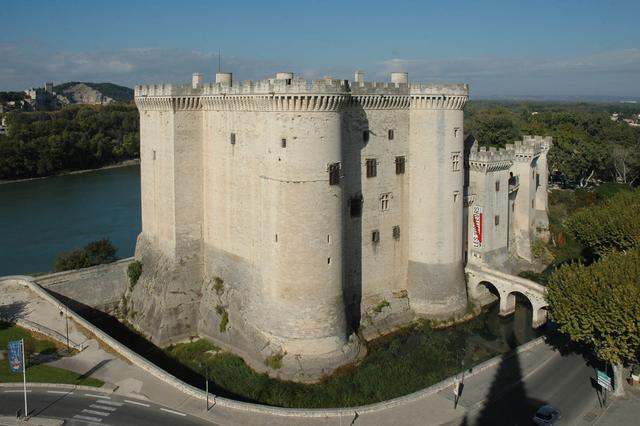
Family days out nearby: Tarascon Castle (18 km), Nîmes Arena (19 km), Musée de la Romanité (19 km)
Swimming pools and play areas nearby, on Google Maps
Facts checked on 29 October 2026. Sources: pontdugard.fr, pontdugard.fr, pontdugard.fr, pontdugard.fr, fr.wikipedia.org
Map
In the same region
- Cosquer Cave (Cosquer Méditerranée)from €18Free under 6